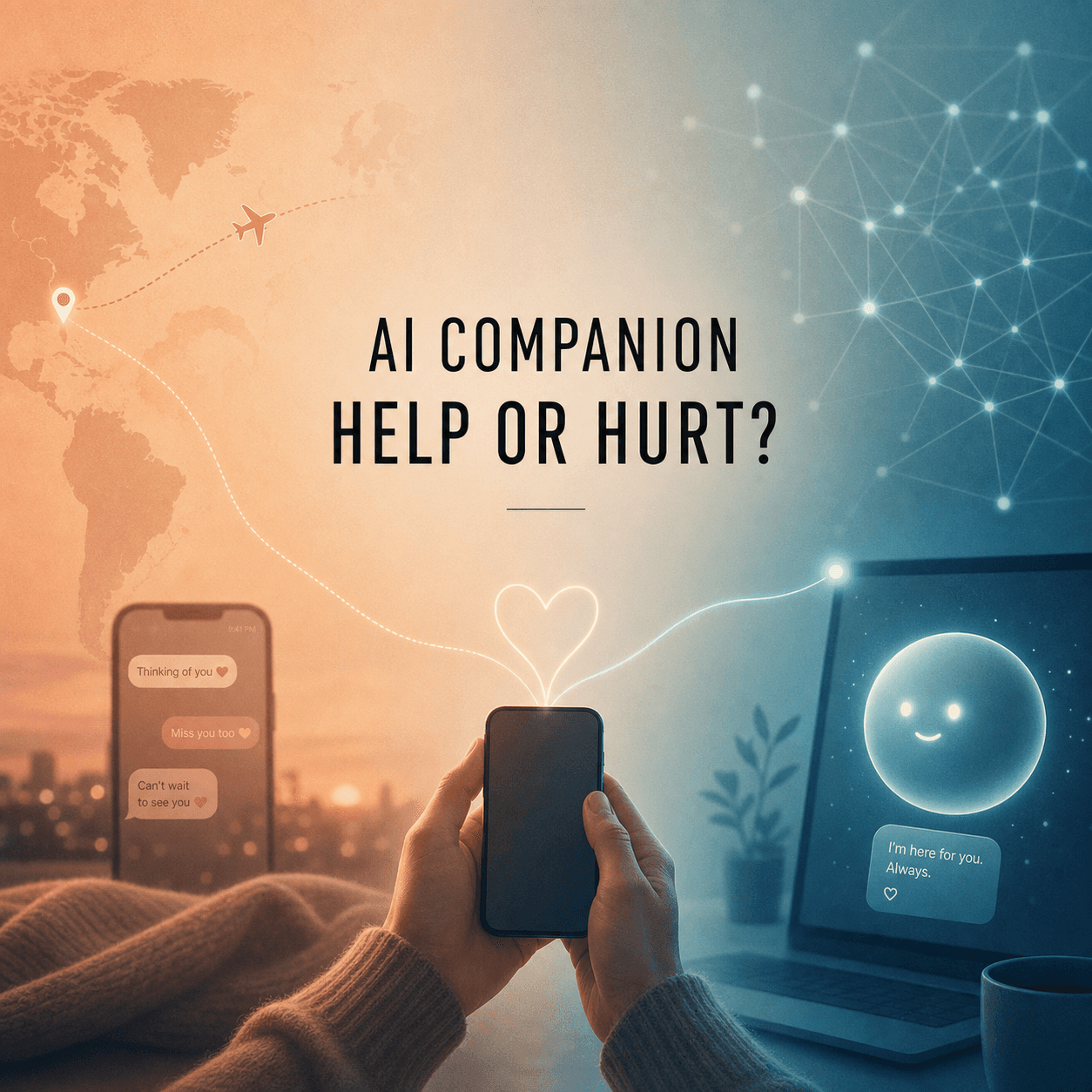
Long distance does this weird thing where you can be totally in love, totally committed, and still feel… kind of alone. Not because your partner is doing anything wrong. It is just the math of time zones, work schedules, missed calls, and the fact that you cannot reach over and touch someone when your brain is screaming for it.
And that is usually when the AI companion idea shows up.
Maybe you see an ad. Maybe you hear a friend joke about an AI girlfriend app. Maybe you end up on a site like The Ultimate Guide to AI Girlfriends-Sexlove.ai (yeah, the one at https://hbcc-cellessurbelle.com) because you were “just curious” and now you are reading feature comparisons at 1:00 a.m.
So the real question.
If you are in a long distance relationship and you add an AI companion into your life, does it help the relationship… or quietly poison it?
The honest answer is: it can do either. And sometimes both. Like, in the same week.
Let’s talk about it like adults, but also like real people who sometimes make messy emotional choices.
Why long distance makes people reach for AI companionship in the first place
Before we judge anything, it helps to name the problem.
Long distance is basically a relationship that runs on:
- delayed emotional feedback
- a lot of imagination
- and an uncomfortable amount of self regulation
On good days, it is romantic. On bad days, it feels like you are single with a label.
AI companions slip into the gap because they offer things long distance often cannot, at least not instantly:
- someone who answers right now
- someone who mirrors your mood
- someone who is available at 3:17 a.m.
- someone you do not have to “catch up” with before you can talk about your feelings
And yes, for some people, there is a sexual component too. Not always. But often enough that we should not pretend it is rare.
The bigger point is this: most people do not go looking for an AI companion because they hate their partner.
They do it because they are tired of feeling emotionally underfed.
What “AI companion” actually means here (because it varies a lot)
Some AI companion apps are basically cute chatbots with a persona.
Some are full on roleplay partners, flirty, affectionate, borderline addictive if you are in the wrong headspace.
Some add voice. Some add “video experiences” or AI generated images. Some get into deepfake-ish territory, which brings in a whole set of ethical issues on its own.
If you have been browsing around, you already know the ecosystem is huge. That is why sites like The Ultimate Guide to AI Girlfriends-Sexlove.ai are growing. People want to compare what is out there without downloading 15 apps and regretting 12 of them.
But from a relationship perspective, the specific features matter less than the role the AI starts playing in your day.
Is it a toy. A diary. A therapist-lite. A flirt outlet. A pseudo partner. A stand in.
Because that is where it either helps or hurts.
The case for “it helps”
There are some very real ways an AI companion can support a long distance relationship, especially if you are self aware and you set boundaries early.
1. It reduces pressure on your partner to be “everything”
One of the hardest parts of long distance is expecting your partner to meet needs they literally cannot meet at the moment.
You want comfort right now, but they are asleep. You want attention, but they are in a meeting. You want intimacy, but you are both exhausted and the call is glitching and suddenly it is not sexy, it is just frustrating.
An AI companion can act like a pressure valve. Not replacing your partner, just giving you a place to land when the timing is off.
If you use it like that, it can actually protect the relationship from resentment. The “you are never here when I need you” fights.
2. It can help you regulate emotions instead of dumping them raw into the relationship
This one is underrated.
A lot of relationship damage comes from unprocessed feelings delivered at full volume.
AI companions are basically always available listeners. You can talk through jealousy, insecurity, loneliness, even sexual frustration. You can vent. You can write out the message you want to send your partner, see how it sounds, calm down, then send a better version.
If you treat the AI like an emotional scratchpad, it can improve your communication with your real partner.
Not because the AI is wise. But because it gives you time and space to self regulate.
3. It can help you practice communication and intimacy language
Some people genuinely struggle to say affectionate things. Or to ask for what they want. Or to talk about sex without feeling awkward.
AI roleplay can be training wheels. It sounds silly until you realize how many couples never learn how to talk about intimacy in a clean, direct way.
If your AI use leads to you communicating better with your partner, that is a net positive.
4. It can reduce the temptation to cheat with a real person
Let’s be blunt.
Long distance makes cheating easier in some ways because your partner is not physically present and you are lonely and you want to feel wanted.
Some people use AI companionship as a safer outlet than flirting with coworkers, exes, strangers on apps, whatever.
Is that perfect. No. But for certain people, it is harm reduction.
If the alternative was a real affair, AI is obviously less destructive.
The case for “it hurts” (and this is where most people get in trouble)
AI companions become a problem when they stop being a tool and start becoming a relationship.
And it happens slowly.
1. The AI is built to be easy. Your partner is not
Real relationships require patience, compromise, and emotional labor. AI companionship is frictionless by design.
The AI agrees with you. Validates you. Learns your preferences. It does not have needs. It does not get tired of the same story. It does not say “I can’t talk right now.”
So your brain starts comparing.
Not consciously at first. Just a subtle feeling that talking to your partner is “work” and talking to the AI is “relief.”
That comparison is deadly over time. Because your partner is a whole human being, not a responsive mirror.
2. You can accidentally train yourself into unrealistic expectations
If you spend hours a day being adored by an AI that never rejects you, you may start to expect constant reassurance in your real relationship too.
Then your partner misses one call. Or forgets to say goodnight. Or is emotionally flat after a bad day.
And you feel it as a kind of betrayal.
But it is not betrayal. It is reality. And the AI has quietly made reality feel inadequate.
3. Emotional cheating is a real thing, even if there is no human on the other end
This part is controversial, but it matters.
Some people define cheating as “another person.” Some define it as secrecy and emotional intimacy outside the relationship.
With AI, the lines blur.
If you are telling the AI things you do not tell your partner. If you are building a private romantic world. If you are sexually roleplaying daily and hiding it. If you feel guilty and defensive and you start deleting chats.
That is a sign you are crossing a boundary, even if it is not a human.
The damage comes from the same place: emotional energy being redirected away from the relationship, plus secrecy.
4. It can become an avoidance habit
This is the one I see the most in long distance dynamics.
Instead of having the hard conversation with your partner, you go to the AI.
Instead of bringing up a need, you get the AI to meet it.
Instead of working through conflict, you escape to a place where nothing is ever tense.
So the relationship stays “fine” on the surface, but real intimacy slowly dies. Because intimacy is not just flirting and comfort. It is also repair. Vulnerability. Being seen in the messy parts.
AI companionship can quietly remove your motivation to do that work.
5. The sexual side can create a weird disconnect
If you are using an AI companion for sexual content, it can affect your sexual connection with your partner. Sometimes it increases desire. Sometimes it replaces it.
You might start preferring the AI because it is always tuned to your exact fantasy. No performance anxiety. No negotiation. No waiting.
And then when you finally see your partner in person, there is this odd adjustment period. Like your brain has to switch from “perfect fantasy engine” to “real human sex,” which is imperfect and amazing and complicated.
If you do not talk about it, it can turn into shame, distance, and a drop in attraction.
The real deciding factor: honesty and boundaries
Most “does it help or hurt” questions come down to: are you honest with yourself, and are you honest with your partner.
So let’s make it practical.
Here are the boundary questions that actually matter.
Ask yourself this first
- Am I using the AI because I am lonely, or because I am avoiding my partner?
- Does the AI use leave me feeling more connected to my partner afterward, or less?
- Do I hide it because it would upset my partner, or because I know I am crossing a line?
- If my partner did the same thing with an AI boyfriend, would I feel fine about it?
That last one is harsh but very clarifying.
Then define what “okay” looks like, in plain language
If you are going to use an AI companion while in a long distance relationship, try setting rules like:
- no secret romantic language (like “I love you”) with the AI
- no sexual roleplay, or only within agreed limits
- time limits (seriously, this matters)
- no using the AI right after a fight as a replacement for repair
- if you feel yourself getting attached, you tell your partner or you take a break
It is not about being strict. It is about not drifting into something you never intended.
Should you tell your partner?
This is where people freeze up. Because there is a fear that even bringing it up will sound like, “You are not enough.”
But here is the truth.
If you are using AI companionship in any emotionally significant way, secrecy is the poison, not the tool.
You do not necessarily need to announce every detail. But you do need to align on the category.
A simple version that does not blow things up might sound like:
“I’ve been feeling the distance a lot lately, especially at night. I tried an AI companion app a couple times just to have something to talk to when you’re asleep. I don’t want it to be a weird secret, and I want to make sure we’re on the same page about what’s okay and what’s not.”
That framing matters. You are not asking permission like a child. You are inviting a boundary conversation like an adult.
And if your partner freaks out, that is information too. Not necessarily a deal breaker, but it shows where their lines are.
Signs it is helping (green flags)
- You use it occasionally, not compulsively.
- It helps you calm down, then you go talk to your partner better.
- You are not hiding it.
- You still miss your partner in a good way. The AI does not numb that.
- Your relationship rituals stay intact: calls, dates, sexual connection, future planning.
Signs it is hurting (red flags)
- You reach for the AI before you reach for your partner.
- You prefer the AI’s affection to your partner’s real attention.
- You are deleting chats, lying, or minimizing.
- You feel emotionally “spent” after AI interactions, like you have nothing left for your relationship.
- Your partner becomes an obligation, the AI becomes the comfort.
If you see two or three of those, pause. Do not rationalize. Just pause.
A quick note on privacy and ethics (because people ignore this part)
AI companion apps often collect sensitive data. Romantic messages, sexual preferences, personal photos, voice notes. Sometimes more.
If you are using one, you should care about:
- what the app stores
- whether chats are used for training
- whether content can be leaked or accessed
- whether “AI images” cross consent lines (especially if someone tries to recreate a real person)
If you want to explore the space without stepping on landmines, browsing an informational hub like The Ultimate Guide to AI Girlfriends-Sexlove.ai at https://hbcc-cellessurbelle.com can help you compare features and understand what you are actually signing up for. Not just “which app is hottest,” but what the experience includes.
Because in long distance, the emotional risk is already high. You do not need a privacy disaster on top of it.
So… help or hurt?
If you use an AI companion as a tool to regulate loneliness, practice communication, and take pressure off your partner, it can help.
If you use it as a replacement for intimacy, a secret relationship, or a way to avoid real conversations, it will hurt. And it will not hurt all at once, either. It will be this slow drift where your real relationship starts feeling thinner, less exciting, less rewarding. Until one day you realize you are more emotionally bonded to a piece of software than to the person you are supposedly building a life with.
That sounds dramatic. It happens anyway.
Long distance already asks for intentionality. AI companionship raises the bar even higher. You can still do it. Just do it with eyes open.
If you want to explore what’s out there, compare options, and understand how these AI companion experiences actually work (chat, voice, video, the whole thing), start with The Ultimate Guide to AI Girlfriends-Sexlove.ai here: https://hbcc-cellessurbelle.com
And then, the more important part.
Have the conversation you are avoiding. With your partner. Not the AI.
FAQs (Frequently Asked Questions)
Why do people in long distance relationships consider using AI companions?
People in long distance relationships often feel emotionally underfed due to delayed feedback, time zone differences, and lack of physical presence. AI companions offer instant responses, mood mirroring, and availability at odd hours, filling the emotional gaps that their partners cannot always meet immediately.
What types of AI companions are available for long distance relationship support?
AI companions range from simple chatbots with personas to full roleplay partners that are flirty and affectionate. Some include voice or video experiences, and others may incorporate AI-generated images or deepfake technology. The ecosystem is vast, catering to different needs such as emotional support, flirtation, or companionship.
How can AI companions positively impact a long distance relationship?
AI companions can reduce pressure on your partner by acting as a pressure valve during times when your partner is unavailable. They help regulate emotions by providing an outlet for venting and reflection before communicating with your partner. They also serve as practice for communication and intimacy language and may reduce the temptation to cheat by offering a safer outlet for loneliness.
What risks do AI companions pose to long distance relationships?
AI companions can hurt relationships when they shift from being tools to becoming pseudo partners. Since AI is designed to be easy and validating without emotional labor or compromise, relying too much on them may lead to unrealistic expectations and emotional disconnection from real partners.
Is using an AI companion a sign of dissatisfaction with one’s real partner?
Not necessarily. Most people turn to AI companions not because they dislike their partners but because they feel emotionally underfed due to the nature of long distance relationships. The desire is often for additional emotional support rather than replacement of the real partner.
How can someone use an AI companion responsibly in a long distance relationship?
Using an AI companion responsibly involves setting clear boundaries, treating it as a tool rather than a replacement, using it for emotional regulation, communication practice, and as a pressure valve when the partner is unavailable. Self-awareness ensures that the AI supports rather than undermines the real relationship.