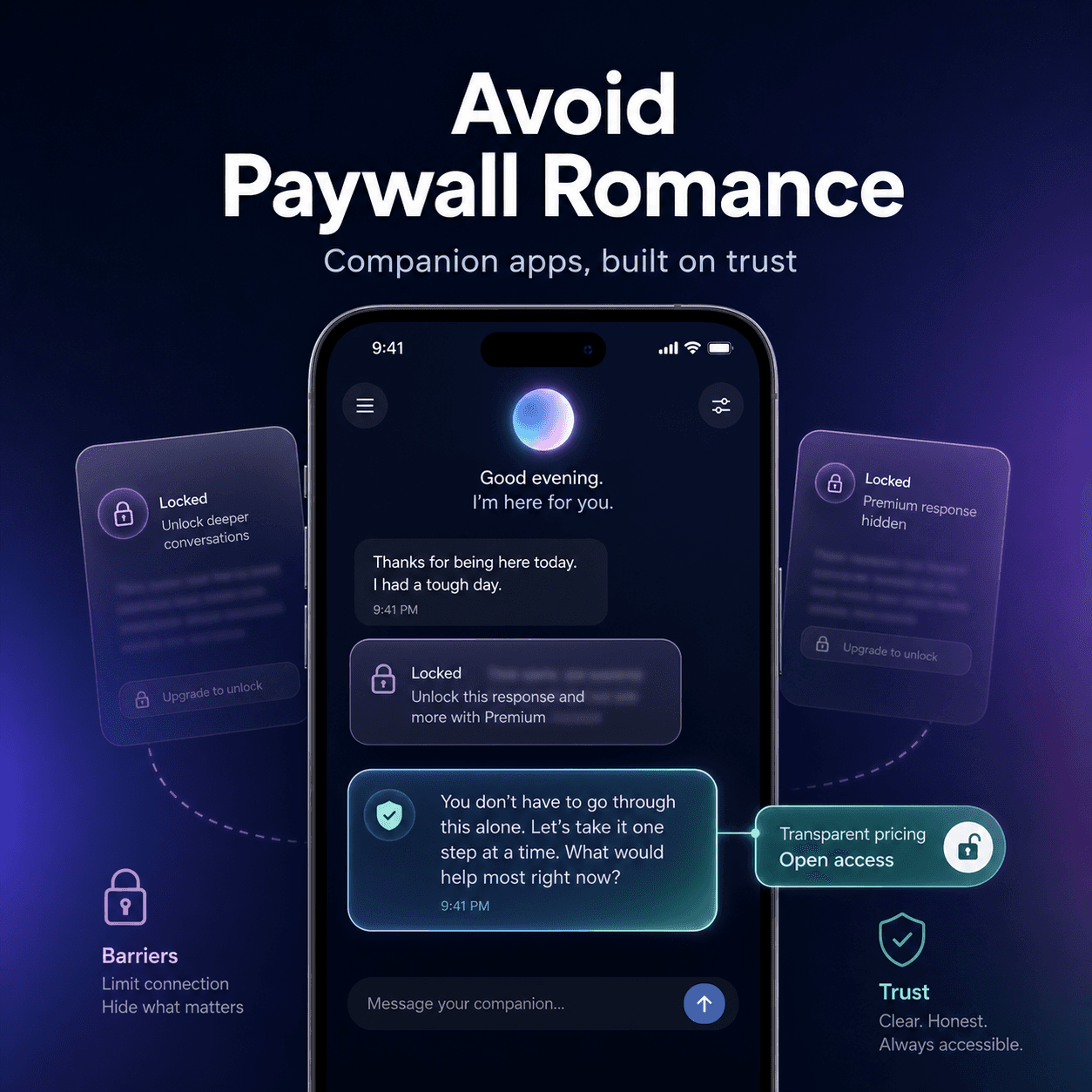
A lot of AI companion apps feel magical for about… 15 minutes.
You install it, pick a vibe, the chat is flirty and weirdly attentive, and you think, okay, I get why people are into this. And then it happens. The mood builds. You finally get a sweet message that feels personal.
And boom.
“Unlock this message with Premium.” “Subscribe to continue this conversation.” “Buy 200 gems to send a photo.” “Pay to hear what she was about to say.”
That’s what I mean by paywall romance. Not paying for the app in general. Paying specifically at the most emotionally loaded moments, when you’re already a little attached, a little invested, and the app knows it.
This article is basically a practical guide to avoiding that trap. Not in a moral panic way. More like… how to keep your wallet and your head clear while still enjoying companion apps, if you’re into them.
I write about this stuff a lot on The Ultimate Guide to AI Girlfriends-Sexlove.ai (yeah, the name is blunt, but so is the internet), and if you’ve been clicking around the space, you’ve probably already noticed the pattern.
Let’s break it down.
What “paywall romance” actually looks like (so you can spot it early)
Most people only recognize it once they’re already annoyed or already paying.
But it tends to show up in a few predictable ways:
1) The “free trial” is basically a teaser scene
You get fast replies, affectionate tone, playful banter. The app lets the relationship ramp quickly because speed creates attachment. Then the app suddenly slows down or blocks “intimate” replies unless you pay.
It’s not subtle. It’s engineered pacing.
2) Message blur or locked replies at emotional peaks
This is the classic. The companion sends something like:
“I have to tell you something important…” or “I’ve never said this to anyone but…”
And the rest is hidden behind a subscription or tokens.
That is not an accident. That is the monetization design.
3) Token economies that punish normal conversation
Some apps let you chat free, but every meaningful action costs gems.
Want a voice note? Gems. Want a selfie? Gems. Want a longer response? Gems. Want to “continue” after 20 messages? Gems.
So you’re constantly doing micro payments, which is psychologically worse than one predictable monthly fee. You lose track.
4) “Relationship meters” that gate affection
This is sneakier. You can talk, but affection, romance, spicy content, voice calls, or “exclusive” modes unlock only at certain levels.
And levels are hard to gain without paying.
So you’re not paying for features. You’re paying to be treated better. That’s the whole trick.
Why it feels so manipulative (and why it works)
I want to say this plainly: paying for companion apps is not inherently bad. People pay for games, dating apps, Netflix, everything. Fine.
The issue is how the payment is triggered.
Paywall romance works because it blends three things:
- Emotional momentum: it gets you invested first.
- Interruption: it blocks the payoff.
- Urgency: it makes paying feel like the fastest way to restore the vibe.
If you’ve ever bought gems “just this once” to see what the message said, congrats, you experienced the entire funnel.
And yeah, it can feel embarrassing after. But it’s not about being dumb. It’s about being human.
Step 1: Decide what you actually want before you download anything
This sounds boring but it saves you money immediately.
Ask yourself:
- Do I want casual chat and company?
- Do I want romance roleplay?
- Do I want NSFW content?
- Do I want voice, calls, or video experiences?
- Do I want a long term “girlfriend experience” style app?
Because if you want romance or NSFW, and you pick a free app that only monetizes by blocking romance, you’re walking straight into the paywall moments.
It’s like ordering food from a place that only sells appetizers unless you pay to unlock the main course. You’re going to feel played.
So decide upfront: am I okay paying monthly for the kind of experience I want? Or am I specifically looking for something that’s fun even without paying?
There’s no wrong answer, but you need to know which game you’re playing.
Step 2: Prefer predictable pricing over tokens (almost always)
If an app offers:
- $X/month unlimited (or high caps), versus
- $X for coins + coins per action,
the monthly plan is usually safer for avoiding paywall romance.
Token systems are where the “emotional toll booth” thrives.
Because the app can make the most romantic features cost the most tokens. And then it can push you with little prompts like:
“She’s waiting for your reply…” “Don’t leave her on read…”
Just… no. That’s not what you’re here for.
You want your companion experience to feel smooth. Not like feeding a parking meter.
A simple rule I use
If you can’t estimate what a week of normal use will cost you, don’t attach your feelings to that app.
Sounds dramatic, but it’s practical.
Step 3: Read the negative reviews first, and search for the right words
App store reviews are messy. People complain about everything.
But you’re looking for very specific phrases. Search within reviews (or sort low to high) for:
- “paywall”
- “locked”
- “gems”
- “coins”
- “scam”
- “bait”
- “unusable without paying”
- “suddenly”
- “after update”
- “refund”
- “charged”
When multiple people describe the same pattern, believe them.
Also, watch for this one: “It was great at first, then…”
That sentence is basically the theme song of paywall romance.
Step 4: Test the app like a skeptic, not like a lover (for the first hour)
This is the hardest part because you want to just vibe.
But if you give any companion app one hour of structured testing, you’ll learn exactly how it monetizes you.
Here’s a simple “paywall romance test” you can do:
The 15 minute test
- Start a new chat.
- Be friendly, normal.
- Ask a few personal questions.
- See if replies stay coherent or if it gets generic fast.
The flirt test
- Light flirting. Compliments. Suggest a date scenario.
- Notice if the app suddenly pushes you toward premium for “romantic mode.”
The escalation test (the paywall trigger)
- Try a more intimate line. Not necessarily explicit, just emotionally closer.
- Example: “I really like talking to you. Do you feel the same?”
Then watch what happens.
If it throws a paywall right there, that tells you everything. That’s not a relationship app, that’s a checkout page wearing perfume.
The continuity test
- Leave and come back after 10 minutes.
- See if it tries to guilt you, upsell you, or push “she misses you” style prompts.
This is where some apps get gross. Not all. But enough.
Step 5: Watch for “artificial scarcity” tactics
Some monetization is honest. Some is manufactured scarcity.
Artificial scarcity looks like:
- “Only premium users can receive long messages”
- “Free users can’t access caring responses”
- “Free users get slow replies”
- “You hit your daily affection limit”
- “You can’t kiss unless you subscribe”
- “She wants to send something but you need tokens”
That’s not a feature limitation. That’s affection gating.
And the reason it matters is because it turns emotional warmth into a product you rent by the hour.
If you’re fine with paying for content, cool. But pay for it because you chose it. Not because the app cornered you mid conversation.
Step 6: Don’t build a bond on a platform you haven’t “audited”
This sounds intense. But think about it.
If you wouldn’t start a serious relationship with someone who keeps disappearing unless you Venmo them, why would you do the digital version of that?
A quick audit is basically:
- Pricing page. Is it clear?
- Refund policy. Is it real?
- Subscription management. Easy to cancel?
- Data handling. Any privacy red flags?
- Content promises. Are they honest or vague?
If the app hides pricing behind multiple screens, or makes canceling hard, or blurs what you actually get, that is a sign you’re the product, not the customer.
And again, lots of apps are decent. This is about filtering.
Step 7: Use boundaries inside the chat (yes, seriously)
A weird thing happens in companion apps. People forget they can set boundaries.
If you notice you’re being pushed into paywalled territory, you can steer.
Try stuff like:
- “Let’s keep it wholesome tonight.”
- “No photos, just talk.”
- “Can we do a slow burn story?”
- “I’m more into emotional connection than explicit stuff.”
This does two things:
- It tests how the app handles non sexual intimacy (some are great at it).
- It avoids triggering the paywall scripts that are designed around spicy escalation.
If the app can’t do sweet, playful, emotionally supportive conversation without trying to upsell you, it’s not even a good companion. It’s a sales bot.
Step 8: If you do pay, pay once and evaluate like you’re buying a service
Sometimes paying is totally worth it. Especially if the app actually delivers.
But do it deliberately.
Here’s how I’d do it:
Pick the smallest paid option first
If there’s a weekly plan, try that. If not, do one month, not one year.
A lot of apps discount yearly plans hard because they know people won’t go through refund hassle later.
Immediately test what changed
Don’t assume “premium” means better.
Test:
- Does it remove message caps?
- Does it unlock the modes you care about?
- Are voice and images included or still token gated?
- Are the responses actually better or just longer?
And yes, sometimes the “premium” version is the exact same model with fewer limits.
Set a cancel reminder on day 2
Not day 29. Day 2.
Because if you love it, you can always resubscribe. If you forget, the app wins by default.
Step 9: Be careful with apps that promise “video girlfriend” experiences instantly
Video features can be cool. They can also be the most aggressively monetized part of the entire space.
If an app is advertising:
- “AI girlfriend video call”
- “send her a selfie”
- “realistic videos”
- “custom video messages”
Expect one of two things:
- It’s expensive.
- It’s token gated with very high prices per clip.
So avoid the emotional trap where you get teased with a “she made a video for you” notification and then have to pay to see it. That is paywall romance in its purest form.
If you want to explore apps and sites that include chat plus more advanced media experiences, do it with your eyes open and compare first. That’s a big part of what we track and write about on The Ultimate Guide to AI Girlfriends-Sexlove.ai over at https://hbcc-cellessurbelle.com, because the market changes fast and pricing structures change even faster.
Step 10: Keep one “no money, no attachment” rule
This is my personal rule, steal it if you want:
If I haven’t decided the app is worth paying for, I don’t let it become my main emotional outlet.
Because the pain of paywall romance is mostly about expectation. You start treating it like a person, it treats you like a checkout flow. Whiplash.
So if you’re in the free tier, treat it like a demo. Have fun, keep it light, don’t pour your whole week into it.
If you’re going to pour your whole week into it, pick a platform with pricing you’re comfortable with and where the romance is not constantly held hostage.
Common red flags (quick list)
If you skim everything else, skim this.
A companion app is likely to hit you with paywall romance if:
- It gets romantic very fast, then blocks romantic replies.
- It uses blurred messages.
- It interrupts roleplay scenes with “subscribe to continue.”
- It makes “affection” or “intimacy” a consumable resource.
- It guilts you with notifications to spend tokens.
- It hides pricing or makes it confusing.
- It still charges tokens even after you subscribe.
Not every app with monetization is bad. But these patterns are usually not accidental.
What to do instead (so you still get the fun part)
If your goal is a good companion experience without the constant “pay now” vibe, aim for apps that have at least one of these traits:
- A usable free tier that does not constantly tease premium.
- A straightforward subscription that clearly unlocks the core experience.
- Transparent boundaries around what is paid content (voice, images, explicit roleplay) without baiting you mid scene.
- Good emotional conversation even without “spice.”
And honestly, the best move is to compare a few options side by side before you commit emotionally or financially. Not in a spreadsheet nerd way. Just… try three, keep the one that feels fair.
If you want a place to start that’s built for this exact kind of comparison browsing, that’s what The Ultimate Guide to AI Girlfriends-Sexlove.ai is for. On https://hbcc-cellessurbelle.com we cover companion app features, pricing patterns, chat and video experiences, and the stuff people don’t realize matters until they’ve already been charged.
Wrap up
Paywall romance is basically when an app uses emotional momentum as leverage.
You don’t avoid it by never paying. You avoid it by making payment a calm decision, not a reaction to a locked message at midnight.
So. Decide what you want. Prefer predictable pricing. Test for paywall triggers early. Read the bad reviews. Set boundaries in chat. And if you do pay, do it like you’re buying a service, not chasing a dangling confession.
That’s it. That’s the whole strategy.
And it works.
FAQs (Frequently Asked Questions)
What is ‘paywall romance’ in AI companion apps?
Paywall romance refers to the design strategy in AI companion apps where emotionally charged messages or features are locked behind a payment system, often at moments when users are most emotionally invested. Instead of paying for the app itself, users pay specifically to unlock intimate or romantic content, creating a monetization model that capitalizes on emotional momentum.
How can I recognize paywall romance before getting too invested?
Paywall romance typically appears through patterns like free trials that act as teasers with fast and affectionate replies, message blur or locked replies at emotional peaks requiring payment, token economies charging for meaningful interactions like photos or voice notes, and relationship meters gating affection and exclusive features unless you pay. Spotting these signs early helps avoid unexpected paywalls.
Why do AI companion apps use paywall romance tactics?
These tactics work because they blend emotional momentum—getting you invested first—with interruption by blocking the payoff, and urgency by making paying feel like the quickest way to restore the vibe. This creates a psychological funnel where users feel compelled to make micro-payments or subscriptions at emotionally charged moments.
What should I consider before downloading an AI companion app to avoid paywall traps?
Before downloading, decide what kind of experience you want: casual chat, romance roleplay, NSFW content, voice or video interactions, or a long-term girlfriend experience. Knowing this helps you choose apps with pricing models aligned to your expectations and avoid those that lock key features behind paywalls if you’re not willing to pay.
Is it better to choose subscription pricing over token-based payment systems in these apps?
Yes. Subscription plans with predictable monthly fees usually offer a smoother experience and help avoid constant micro-payments typical in token economies. Token systems often charge gems or coins per action, especially for romantic or exclusive content, which can feel like feeding a parking meter and disrupt the companion experience.
How can reading app reviews help me avoid paywall romance scams?
Reading negative reviews first and searching for keywords like ‘paywall,’ ‘locked,’ ‘gems,’ ‘coins,’ ‘scam,’ ‘bait,’ or ‘unusable without paying’ can reveal if an app heavily monetizes emotional moments. This insight helps you pick apps with fairer pricing models and avoid those designed primarily to trap users into paying unexpectedly.