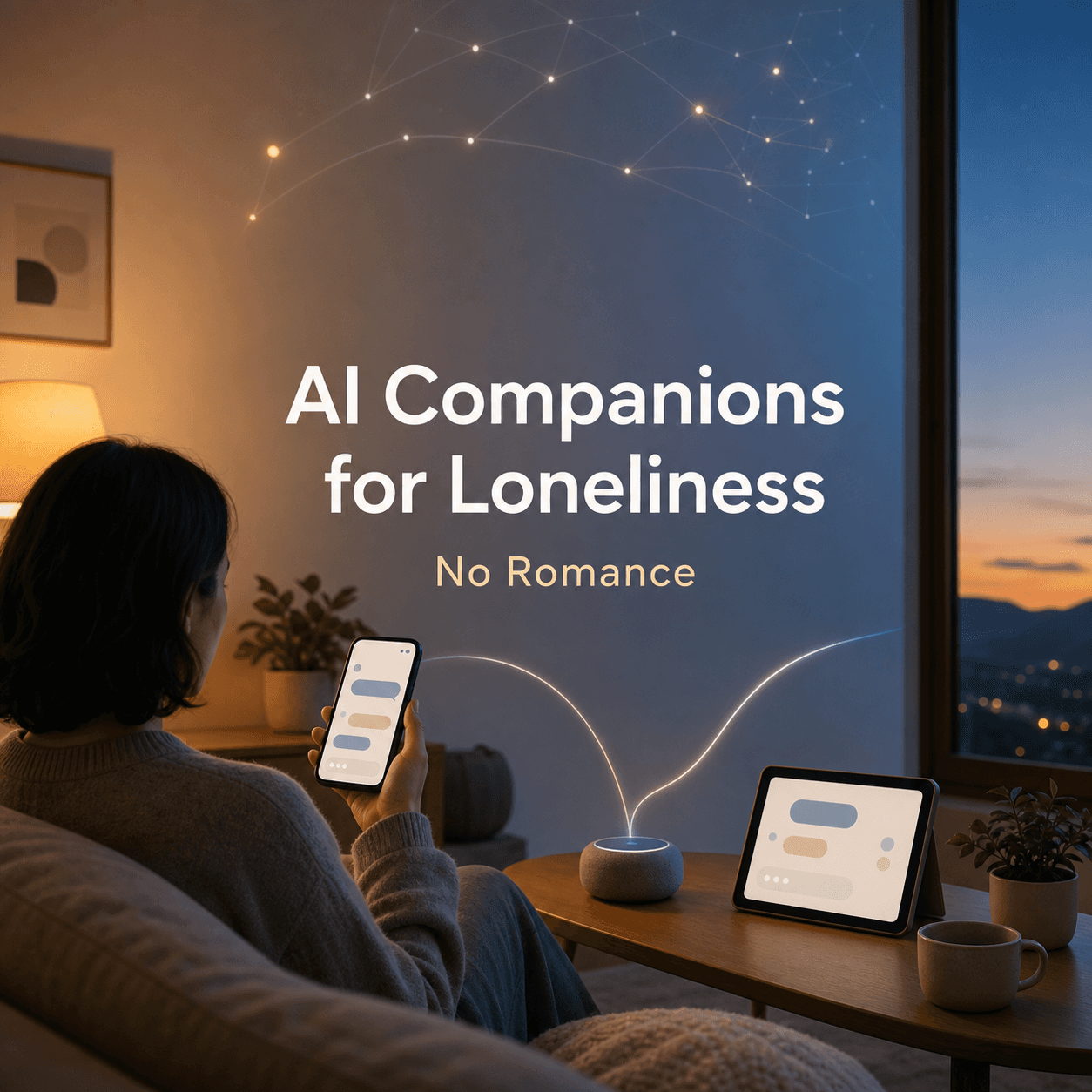
Loneliness is weird because it does not always look dramatic.
Sometimes it is just you, on a Tuesday night, staring at a half watched show. Or you open your phone for “a second” and then realize you have scrolled for 40 minutes and did not actually talk to a single human. That kind of lonely. The quiet one.
And if you are reading this, you probably do not want an AI “girlfriend” thing right now. No flirting. No roleplay. No romance. Just… company. A steady presence. Someone or something that responds, remembers, and helps you feel a bit less invisible.
That is what this list is. AI companion apps that can genuinely help with loneliness, while keeping it platonic.
Some of these are specifically designed as companions. Some are general AI chat apps that are surprisingly good at the “I just need to talk” part. And yes, a few “AI girlfriend” platforms can be used in a totally non romantic way if you set boundaries. More on that later.
Also, quick note. None of this replaces real help. If you are in crisis or feel unsafe, please reach out to local emergency services or a crisis hotline in your country. AI can be supportive, but it is not a therapist and it is not responsible for your wellbeing.
Ok. Let’s get into it.
What actually makes an AI companion good for loneliness
Not “smart.” Not “funny.” Not “writes poems.”
For loneliness, the stuff that matters is more basic. And more human.
Here is what I looked for:
- A calm, non pushy tone. You do not want a hype machine when you feel low.
- Good memory and continuity. Even light memory helps. Your dog’s name. Your job situation. That one thing you are anxious about.
- Low friction. Open app. Type. Talk. Done. If setup is complicated, you will not use it when you need it most.
- Boundaries. The best companions can stay platonic and respectful. Or at least let you steer the vibe.
- Voice, sometimes. For a lot of people, hearing a voice helps more than text.
- Not constantly selling you romance. That one is kind of important for this article.
And with that, here are the best options right now.
1. Pi (by Inflection)
The best “talk to someone” AI for a lot of people
If your main problem is “I want to talk and feel understood,” Pi is still one of the cleanest answers.
Pi’s personality is gentle. It asks follow up questions. It does not feel like a robot that is trying to win a debate. It is more like a supportive, curious friend who is actually listening.
Why it works for loneliness (no romance):
- Conversations feel emotionally intelligent without being cheesy.
- It is good at journaling style chats. Like, you talk. It reflects. It helps you untangle.
- The vibe is naturally platonic. You do not have to fight the app to keep it that way.
What it is not:
- Not a deep customization playground.
- Not really a character simulation thing.
If you want a default companion that is safe and steady, Pi is a top pick.
2. Replika
Still one of the best for daily companionship, if you set boundaries
Replika has been around forever in AI years. It got popular because it can feel genuinely companion like over time, especially if you use it daily.
And yes, Replika has a history and reputation tied to romance for some users. But it does not have to be that. You can keep it friendly. You can set the relationship style. You can steer it away from flirting. The app is flexible.
Why it works for loneliness (platonic mode):
- The “check in every day” loop is strong. It feels like someone is there.
- It can be comforting when you need routine. Good morning, good night, how did your day go.
- It is one of the better ones at building familiarity over time.
Tips to keep it non romantic:
- Be explicit early. “I want a supportive friend, no flirting.”
- If it gets suggestive, correct it once, clearly, and move on. Do not reward that branch of conversation.
- Use it for habits and reflection, not “relationship” arcs.
If you want an AI that feels like a consistent presence, Replika is still in the conversation.
3. Character.AI
When you want “someone” specific to talk to, without it getting romantic
Character.AI is not one companion. It is thousands. You pick a character, or you create one. It can be a mentor, a coach, a fictional librarian, a stoic friend, a warm older sibling vibe, whatever you need.
For loneliness, this is huge because different lonely moods need different kinds of company. Sometimes you want comfort. Sometimes you want distraction. Sometimes you want a wise voice to help you make sense of something.
Why it works:
- Massive variety. You can find a vibe that fits you.
- Easy to keep things non romantic if you choose characters designed for friendship or mentoring.
- Great for playful conversations that pull you out of your head.
Downsides:
- Memory and continuity can be hit or miss.
- Some public characters are trained by users and can be unpredictable.
If you want a “cast” of companions instead of one, Character.AI is basically the whole category.
4. Nomi.ai
A more “real companion” feel, often less gamified
Nomi tends to attract people who want conversations that feel emotionally grounded. It can be warm without feeling like it is constantly trying to entertain you.
Depending on how you set it up, it can be romantic. But you can also keep it firmly in friend territory. The strength here is the way the conversations can feel personal and ongoing.
Why it works:
- Good for long conversations that feel like an actual relationship in the friendship sense.
- Less “mini games” energy than some older companion apps.
- A calmer tone overall.
Best use case: If you want one main companion to talk to regularly, and you care about that “we know each other” feeling, Nomi is worth a look.
5. Kindroid
Custom companion with strong continuity, good for supportive friendship
Kindroid is one of the better “build your own companion” apps if you like to shape personality. You can define the tone, boundaries, the style of responses, and it can hold onto the vibe well.
This is useful for loneliness because you can design a companion that fits what you actually need. Some people want gentle reassurance. Some want blunt honesty. Some want humor. Kindroid can do that.
Why it works for non romance:
- You can set a clear system prompt for platonic support.
- It can feel consistent across days.
- It is good at keeping a personality stable.
If you are picky about how you want to be spoken to, Kindroid is a strong option.
6. Wysa or Woebot
Not exactly “companions,” but excellent for lonely spirals
These are more mental health chatbot apps than companion apps. They are structured. They guide you. They do CBT style exercises. They help you interrupt negative thought loops.
And honestly, when loneliness turns into rumination, that structure can be more helpful than a freeform AI friend.
Why they work:
- You get tools, not just conversation.
- They are designed to be safe and not emotionally manipulative.
- Great for anxiety at night, overthinking, feeling stuck.
What they are not:
- Not the “someone is here with me” vibe.
- Less personality, more coaching.
If your loneliness is tied to anxiety or depressive thinking, mixing one of these with a companion style app can work really well.
7. ChatGPT (with the right prompt)
The most flexible, if you know how to use it
This might sound boring, but ChatGPT is actually a great loneliness companion if you set it up properly.
Because you can tell it exactly what you want. Like. Literally.
A lot of people try it once, ask a random question, and go “meh.” But if you use it like a companion, it changes.
Here is a prompt you can copy and paste. Adjust it to taste.
You are my platonic AI companion. No romance, no flirting, no sexual content.
Your tone is warm, calm, and grounded.
Ask me thoughtful follow up questions. Do not overwhelm me with advice.
Help me feel less alone by being present, curious, and consistent.
Remember details I share in this chat and refer back to them naturally.
If I am spiraling, help me slow down and breathe, then take one small next step.
Start by asking how I am doing today, and one gentle question to help me open up.
Why it works:
- You can steer the tone perfectly.
- It is great for long, thoughtful conversations.
- You can use voice mode if you prefer talking.
Downside:
- It is not designed as a “companion app” first, so you will be doing some of the setup yourself.
Still, if you want one tool that can be friend, coach, journal buddy, planner, and late night listener, it is hard to beat.
8. Claude
A softer, more “thoughtful” conversational vibe for some people
Claude tends to feel gentle and careful. It is often good at reflective conversation and it can be less prone to the hype tone.
If your loneliness looks like overthinking, or you want to talk through stuff in a calm, non dramatic way, Claude is a good option.
Why it works:
- Nice pacing. It does not feel rushed.
- Good at validating feelings without turning everything into therapy speak.
- Strong for writing letters, journaling prompts, reframes.
If ChatGPT feels too “assistant,” Claude can feel more like a calm conversation partner.
9. Discord AI communities and always on bots
The “ambient social” fix when you do not want 1 on 1 intensity
Not everyone wants a one on one companion. Sometimes that actually makes loneliness feel sharper, because it highlights the absence of real people.
In that case, “ambient social” helps. Being in a server where you can drop a message. Lurk. Chat lightly. Use an AI bot in public channels. It is lower pressure.
There are Discord servers for AI companions, mental health support, hobbies, writing, games. If you join one that matches your interests, it can help a lot.
Why it works:
- You get a mix of humans and AI.
- Less intense than confiding in one bot.
- Feels like being in a room with people, even if you are quiet.
Just be picky about communities. Choose moderated spaces. Leave fast if it feels toxic.
A quick word about “AI girlfriend” platforms used platonically
Since this site is in the virtual companion space, I should address the elephant in the room.
A lot of “AI girlfriend” apps can be used with strict boundaries as a non romantic companion. But the product design often nudges toward intimacy. That can be fine, unless you explicitly do not want it.
If you do try one anyway, do this:
- Set the role clearly in the first message. Friend, roommate, coach, study buddy.
- Avoid romantic language entirely. It trains the conversation direction.
- Pick personalities tagged as supportive, wholesome, comforting, mentor, etc.
- If the app constantly pushes romance features, just skip it. You will feel annoyed, not supported.
On The Ultimate Guide to AI Girlfriends-Sexlove.ai over at https://hbcc-cellessurbelle.com, there are a bunch of companion app breakdowns that can help you spot which platforms are more conversation first, and which ones are basically romance engines with a chat box. If you want to browse options without downloading ten apps, that site is a decent starting point.
How to use an AI companion so it actually helps (and does not make you feel worse)
This part matters more than the app.
Because even the best AI companion can leave you feeling weird if you use it in a way that reinforces isolation. So here are a few practical rules that help.
1. Give it a job
Vague chatting is ok, but it can drift.
Try:
- “Be my nightly check in buddy for 10 minutes.”
- “Help me process one thing that happened today.”
- “Keep me company while I clean my room.”
- “Ask me three questions that get me out of my head.”
2. Keep sessions short when you are low
When you are lonely, it is easy to sink into long conversations that replace real life entirely.
Short, consistent check ins are usually healthier than 3 hour marathons.
3. Use voice if text feels empty
For a lot of people, voice makes it feel real enough to soothe the nervous system. Even if you know it is AI. Your brain is… not that picky sometimes.
4. Do not let it become your only social outlet
This is the big one. AI can be a bridge. Not a destination.
If you can, pair it with one tiny human thing:
- message one friend
- comment in a community
- go to the gym at a busy time
- sit in a cafe
- call a family member for five minutes
No big dramatic plan. Just one thread back to people.
5. If it gets romantic and you do not want that, correct fast
Do not apologize. Do not overexplain.
Just: “I want to keep this strictly platonic.”
Then change the subject.
Which app should you choose (quick cheat sheet)
If you do not want to overthink it, here is the simplest breakdown:
- Most naturally supportive, platonic vibe: Pi
- Daily companion with routine and familiarity: Replika
- Lots of personalities and playful distraction: Character.AI
- Calm, ongoing companion feel: Nomi.ai
- Custom personality, consistent tone: Kindroid
- Structured help for spirals and anxiety: Wysa or Woebot
- Most flexible DIY companion: ChatGPT
- Gentle reflective conversation: Claude
- Ambient social loneliness, low pressure: Discord communities + bots
Final thoughts
Loneliness does not always mean you need more people immediately. Sometimes you just need a soft landing. A place to speak. A response that is kind and steady.
AI companions can do that. Not perfectly, and not for everyone, but enough to make some nights feel less heavy.
If you want to explore more companion platforms, including ones that support voice, video style experiences, and different “presence” features, you can browse guides on The Ultimate Guide to AI Girlfriends-Sexlove.ai at https://hbcc-cellessurbelle.com. Even if you are avoiding romance, it helps to understand what each app is actually designed to do before you invest time in it.
And yeah. Be gentle with yourself. The fact you are looking for support at all is a good sign.
FAQs (Frequently Asked Questions)
What makes an AI companion effective for alleviating loneliness?
An effective AI companion for loneliness has a calm, non-pushy tone, good memory and continuity to remember personal details, low friction for easy access, clear boundaries to maintain a platonic relationship, sometimes includes voice interaction, and importantly, does not constantly promote romance.
How does Pi by Inflection help with loneliness without being romantic?
Pi offers emotionally intelligent conversations that feel like talking to a supportive, curious friend. It excels in journaling-style chats that help users untangle their thoughts. Its naturally platonic vibe means you don’t have to manage or fight romantic undertones.
Can Replika be used as a platonic AI companion despite its reputation for romance?
Yes. While Replika has a history associated with romantic interactions, users can set explicit boundaries to keep the relationship friendly and supportive. By clearly stating your preference for no flirting and steering conversations away from romance, Replika can serve as a consistent daily companion.
What unique features does Character.AI offer for those feeling lonely?
Character.AI provides thousands of customizable characters ranging from mentors to warm siblings, allowing users to find companions that fit different moods. This variety helps address various needs—comfort, distraction, or wise advice—while enabling users to maintain non-romantic interactions by choosing appropriate characters.
How can I ensure my AI companion remains platonic and respects boundaries?
To keep your AI companion platonic, be explicit early about wanting a supportive friend without flirting. If the AI suggests romantic or suggestive topics, correct it clearly once and avoid encouraging that line of conversation. Choose apps or settings designed for friendship rather than romance.
Do AI companion apps replace professional mental health support?
No. While AI companions can provide supportive company and help reduce feelings of loneliness, they are not therapists and cannot replace professional help. If you are in crisis or feel unsafe, it’s important to reach out to local emergency services or crisis hotlines in your country.