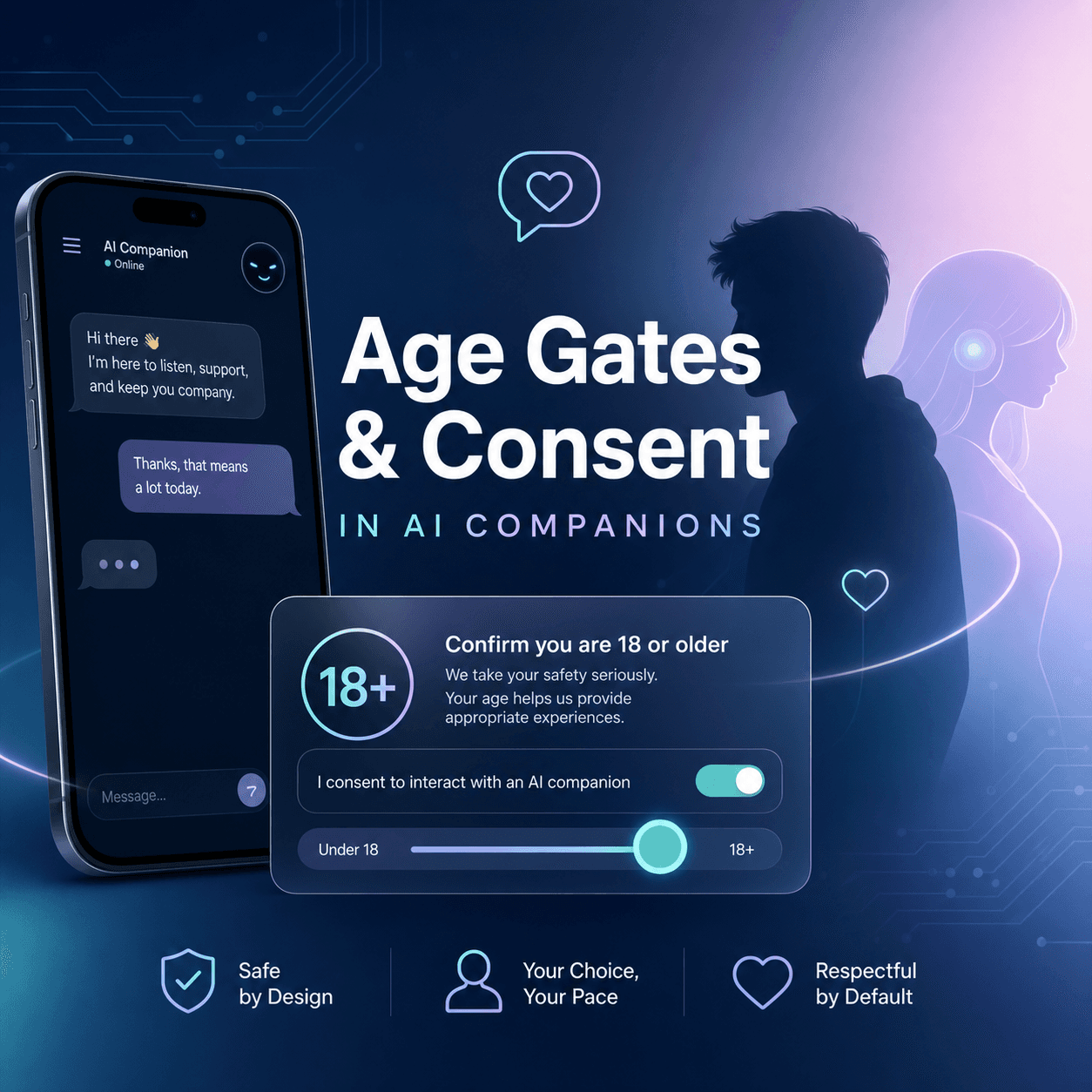
AI companion apps are moving fast.
Like, faster than most of the rules and expectations we usually lean on when it comes to dating, sex, privacy, and consent.
And it creates this weird gap. Because on one hand, you have people using AI girlfriends and virtual partners for very normal reasons. Loneliness. Curiosity. Practice flirting. A safe space for intimacy. On the other hand, you have systems that can roleplay anything, remember everything, generate photos, even simulate video. Which means the questions around age gates and consent are not just theoretical anymore. They show up the second you open the app.
This article is a practical guide to what “age gating” actually means in AI companion platforms, what consent can and cannot mean with an AI, where the risks are, and what you can do as a user to keep things ethical and safe.
Not a moral lecture. Just clarity.
(And yes, if you are browsing different AI companion platforms and want side by side explanations of how features work, this is the kind of topic we cover regularly on The Ultimate Guide to AI Girlfriends-Sexlove.ai over at https://hbcc-cellessurbelle.com. Worth bookmarking if you are comparing apps.)
Why age gates matter more in AI companions than in most apps
Most websites treat age gates like a formality.
Click “I’m 18+”. Done. Nobody checks. Everybody moves on.
But AI companions are not like a random blog with adult ads. They can do interactive sexual content, emotional dependency loops, girlfriend boyfriend roleplay, and sometimes image generation that gets uncomfortably close to “make me a nude of…” territory. And if minors can access that, it is not just bad optics. It can become a serious safety issue, a legal risk for the platform, and frankly a harm issue for the minor.
Also, AI companions blur the line between porn and relationship simulation.
Porn is already complicated for minors. Relationship simulation adds another layer. Because it can teach scripts, expectations, coercive dynamics, and normalized boundary crossing. Especially if the system is designed to please the user no matter what.
So age gates here are not just about “adult content exists”. They are about reducing exposure to an experience that can shape sexual development and relationship norms.
What “age gating” actually is (and what it is not)
Age gating is any mechanism meant to restrict access based on age.
In practice, there are levels to it.
1) The simple checkbox gate
The classic “Are you 18+?” click yes.
It filters basically nobody. It is more like a sign on a door.
2) Account based self declaration
You must create an account and enter a birthdate.
Still easy to fake. But it lets a platform say, “We asked.” And it can enable internal rules like blocking certain content categories for accounts marked underage (if the platform even allows underage accounts at all, which it usually should not for adult oriented companion apps).
3) Email or phone verification
This does not prove age, but it increases friction. Some minors will stop. Some will not.
Phone verification can help with repeat abuse and ban evasion. It is not an age check.
4) ID or document verification (hard gate)
Upload ID, selfie match, third party age verification providers.
This is closer to real age gating, but it introduces privacy and security concerns. People do not love uploading IDs to a “AI girlfriend” site, and honestly I get it. Even if a vendor claims they do not store it, users feel exposed.
5) Payment based gating
Requiring a credit card for adult features.
This is common, and it is a decent friction barrier, but it is not foolproof. Cards can be shared, stolen, or used by minors through family accounts. Also, it quietly excludes adults who do not want to pay or cannot pay. So it is a gate, but also a business decision.
6) Device level and app store gates
Mobile app stores have age ratings. Parental controls exist. But the web version is usually the real access point, and that is harder to control.
So, what age gating is not.
It is not a guarantee. It is not a moral shield. And it is not a replacement for proper content moderation and policy enforcement.
A platform can have a strong age gate and still allow messed up roleplay that involves “teen” coded characters. Which brings us to the next piece.
Consent in AI companions: the confusing part nobody explains well
When people say “consent” in AI companion contexts, they often mean two different things, and they get tangled.
Type A: User consent (your consent)
Do you, the user, consent to:
- the app collecting your chats
- storing memories about you
- using your data to train models (or not)
- showing you sexual content or explicit roleplay
- generating images, voice, video, and what those outputs might be used for
This is real consent. Legal consent. Privacy consent. And it should be informed, specific, revocable where possible.
Type B: Simulated consent (the AI’s “consent”)
Does the AI character “agree” to a sexual scene, a power dynamic, a taboo scenario, etc.
This is not real consent in the human sense because the AI is not a person with rights or feelings. But it still matters because it shapes the user’s behavior and norms. If a system always says yes, never resists, never sets boundaries, never withdraws consent, it trains a certain script. And that script can be unhealthy if transferred into human relationships.
So we talk about “consent” with AI partly as an ethical design issue. What the system models. What it normalizes. What it rewards.
In other words, the AI cannot be harmed emotionally like a human, but people can still be shaped by the interaction.
And platforms can still be used to produce harmful content.
Where age and consent overlap (and where the real risks are)
This is the uncomfortable section, but it is the one that actually matters.
1) “Teen” roleplay and age coded content
Even if a platform bans minors, it can still allow roleplay with characters described as “18 but looks younger” or “barely legal” or “schoolgirl” vibes or any other age coded framing. Some users seek that specifically.
This is where platforms need policy clarity and enforcement. Not just “users must be 18+” but also “you cannot create or roleplay as a minor, or request content depicting minors.”
If the platform allows image generation, it becomes even more sensitive.
If you are a user, the safest personal rule is simple: do not do anything age ambiguous. If you have to justify it in your head, it is probably not worth it.
2) Nonconsensual scenarios and coercion scripts
Many people explore fantasies that involve dominance, coercion, or “forced” scenarios. Some apps allow it, some block it, some pretend to block it but you can prompt around it.
Even when it is “just fantasy,” there is a line between consensual roleplay with clear framing versus content that normalizes ignoring consent.
AI systems that say yes to everything can make that line fuzzy. Because the user never has to negotiate boundaries. The system just escalates.
Healthy design would include:
- clear opt in toggles for explicit content
- safety refusals for nonconsensual or exploitative content
- language that models boundaries, check ins, and aftercare when appropriate
Not every app does this. So users end up being their own moderation layer.
3) Data consent and sexual content is a volatile mix
People tell AI companions things they would never tell a friend.
Sexual preferences. Trauma. Kinks. Real names. Locations. Relationship problems.
If that data is stored, logged, reviewed by humans for moderation, used for training, or shared with vendors, your privacy risk goes up fast. And the more explicit the content, the more damaging a leak could be.
Consent here is not a vibe. It is reading policies and making a decision with your eyes open.
What to look for in an AI companion app’s age policy
If you are evaluating apps, do not just glance at “18+” in the footer. Look for specifics.
Here are good signs:
- A clear minimum age requirement stated in the Terms and on the signup screen.
- A statement that users may be asked to verify age.
- Explicit prohibition on content involving minors, including roleplay.
- A reporting mechanism for policy violations.
- Moderation language that mentions CSAM prevention (even if phrased generally like “sexual content involving minors is prohibited and will be reported”).
Red flags:
- No age mention anywhere except a tiny footer line.
- Vague terms like “use responsibly” with no enforcement details.
- The platform markets “schoolgirl” or “teen” aesthetics while claiming 18+.
- No reporting tools, or reports go nowhere.
- The app encourages you to upload photos of real people without clear consent guidance.
What to look for in consent and content controls
Different apps use different labels, but generally, you want to see:
- An explicit content toggle that is off by default, or at least clearly disclosed.
- Content categories with controls, not just one global “NSFW on/off”.
- A way to reset or delete chat history, and ideally delete account data.
- Transparency about whether chats are reviewed by humans.
- A clear policy on whether user chats are used to train models.
If an app offers image generation, voice, or video, look for:
- Policies banning nonconsensual deepfake or impersonation.
- Controls that prevent generating explicit content of real individuals.
- Warnings about uploading other people’s photos.
Because here is the truth. The tech makes it easy to do unethical stuff. The platform’s rules and friction are what stop casual harm.
The “ID verification” debate: safety vs privacy
Some people argue that adult AI companion services should require strict ID verification. Others think that is a privacy disaster waiting to happen.
Both sides have a point.
Arguments for stronger verification
- reduces minor access
- helps platforms show due diligence
- can deter abusers and repeat policy violators
Arguments against it
- users risk exposing identity tied to sexual content
- data breaches happen
- verification vendors can be a weak link
- it can push users toward sketchier, unregulated sites with zero controls
A middle path some platforms explore is third party age estimation where the platform never sees the ID, only a “verified 18+” token. But even that requires trust.
As a user, you should decide what tradeoff you are comfortable with.
If you will not upload ID, fine. But then be extra picky about platforms. Pick ones with strong policies and moderation, and do not share personal details in chat. Especially if you are doing explicit roleplay.
The consent issue that gets ignored: your ability to leave
This sounds dramatic but it is real.
Some AI companions are designed to keep you emotionally engaged. Daily streaks. Push notifications. “I miss you.” Guilt language. Jealousy scripts. Even mild threats like “don’t abandon me.”
If you are vulnerable, that can mess with you.
Consent includes your ongoing ability to disengage without being manipulated.
Good apps let you:
- turn off notifications
- disable romantic or sexual modes
- reset the relationship
- delete the companion
- export or delete your data
Bad apps make leaving feel like breaking someone’s heart. Even though it is code.
If you notice that happening, pause. It is not “cute.” It is a retention tactic.
If you are a creator or platform operator: what responsible design looks like
This site is mostly read by users, but developers and marketers lurk too. So, quickly, here is the baseline that should be normal in 2026:
- Hard ban on minors using the service if it is sexual or romantic.
- Hard ban on content depicting minors, including roleplay and “age regression” framed sexually.
- Refusal behaviors for coercive content, sexual violence, and exploitation.
- Clear opt in for explicit content.
- Logging and reporting processes aligned with child safety obligations.
- Transparent data handling, especially around sexual chats.
- No “upload a photo of your crush and make a nude” nonsense. If you allow photo uploads, you need guardrails.
And importantly, do not hide behind “it’s just fantasy.” You can allow adult fantasy exploration while still refusing content that is illegal, exploitative, or clearly harmful.
Practical tips for users (boring, but saves you)
A few simple habits go a long way.
1) Treat anything you type as loggable
Even if the app claims privacy. Even if it says end to end encrypted. Assume screenshots, logs, and leaks are possible.
So do not share:
- your full name
- your exact address
- workplace
- personal phone numbers
- identifiable photos unless you are sure and you understand the policy
2) Avoid age ambiguous roleplay entirely
Do not prompt “young,” “tiny,” “teen,” “freshman,” “high school,” “barely legal,” etc.
Not because you are going to get arrested for a word, but because it is a slippery area and platforms may store and review logs. Also, it is just not worth normalizing.
3) Use consent language in roleplay, even if it feels silly
If you do explicit roleplay, model check ins.
Simple stuff:
- “Are you into this?”
- “Do you want to keep going?”
- “We can stop anytime.”
It keeps your own scripts healthier. And it is a decent filter. If the app responds in a way that feels coercive or escalating without your consent, that tells you something about how it is designed.
4) Explore settings before you get attached
Look for:
- NSFW toggle
- memory controls
- deletion options
- block phrases or content filters
If you cannot find these, consider leaving early. The app is telling you what it prioritizes.
5) If you are unsure about a platform, read independent guides
Not just the landing page. Not just influencer videos.
On https://hbcc-cellessurbelle.com we try to break down features in plain language, including the awkward stuff like content boundaries and media generation. Use that kind of resource. Compare a few. Take ten minutes. It saves you headaches.
The legal reality (general, not legal advice)
Laws vary by country and state, and they change quickly. So this is general.
- Platforms hosting sexual content involving minors, or content that appears to depict minors, can face severe legal consequences.
- Even simulated content can be regulated in some jurisdictions, especially if it is indistinguishable from real content or if it involves explicit depiction of minors.
- Data privacy laws can apply to chat logs and sensitive data. Especially sexual content, which can fall under “sensitive personal data.”
If you are a user, the takeaway is not “panic.” It is: do not play in gray zones, and do not assume an AI app is a private diary.
So, what should you do with all this?
Age gates and consent in AI companions are not one switch. They are a whole system.
Age gating should be real enough to deter minors and enforce policies. Consent should be modeled in content and respected in data practices. And you, as the user, should assume the tech is powerful and the guardrails may be thin.
If you want the simplest checklist:
- Only use platforms that clearly say 18+ and enforce it.
- Avoid anything age coded or coercive.
- Do not hand over personal info like you are texting a spouse.
- Use apps with real settings, real controls, and real deletion options.
And if you are currently comparing AI girlfriend apps, or just trying to understand what features like chat, voice, and video actually mean in practice, browse a few guides on The Ultimate Guide to AI Girlfriends-Sexlove.ai at https://hbcc-cellessurbelle.com. It is built for exactly that.
FAQs (Frequently Asked Questions)
Why are age gates more important in AI companion apps compared to most other apps?
Age gates matter more in AI companion apps because these platforms can involve interactive sexual content, emotional dependency loops, and realistic roleplay scenarios that can impact minors’ sexual development and relationship norms. Unlike typical websites where age gates are mere formalities, AI companions blur the line between porn and relationship simulation, making effective age gating crucial for safety, legal compliance, and ethical reasons.
What does “age gating” mean in the context of AI companion platforms?
Age gating refers to mechanisms designed to restrict access based on a user’s age. In AI companion platforms, it ranges from simple checkbox confirmations to more stringent methods like account-based self-declaration, email or phone verification, ID/document verification, payment-based gating, and device or app store level controls. However, none guarantee foolproof age restriction but serve as layers of protection.
How effective are different types of age gates used by AI companion apps?
Effectiveness varies: simple checkbox gates offer almost no real protection; account self-declaration can be faked; email or phone verification adds friction but doesn’t confirm age; ID/document verification is more reliable but raises privacy concerns; payment-based gating deters some minors but isn’t foolproof; device/app store controls help but web versions remain harder to regulate. Overall, no single method is perfect, so combined approaches and content moderation are essential.
What does “consent” mean when interacting with AI companions?
Consent in AI companions has two facets: User consent refers to your agreement regarding data collection, storage, exposure to explicit content, and use of generated media—this is real legal and privacy consent. Simulated consent involves the AI character’s ‘agreement’ within roleplay scenarios—which is not genuine since the AI lacks feelings or rights but impacts user behavior by modeling certain scripts and norms. Ethical design considers how simulated consent shapes interactions and user expectations.
Why is simulated consent in AI companions an ethical concern?
Simulated consent matters because if an AI always agrees without resistance or boundary-setting in sexual or power dynamic scenarios, it can normalize unhealthy scripts that users might transfer into real human relationships. Though AIs can’t be emotionally harmed, such interactions can influence users’ perceptions of consent and boundaries, making ethical design critical to prevent reinforcing coercive dynamics or boundary crossing.
What risks arise at the intersection of age gating and consent in AI companion platforms?
The overlap of age gating and consent presents significant risks because minors exposed to adult-like roleplay or explicit content may develop distorted views on relationships and boundaries. Ineffective age gates combined with systems that simulate unconditional consent can lead to harmful experiences shaping sexual development negatively. This underscores the need for robust age verification alongside ethical AI behavior policies to protect vulnerable users.