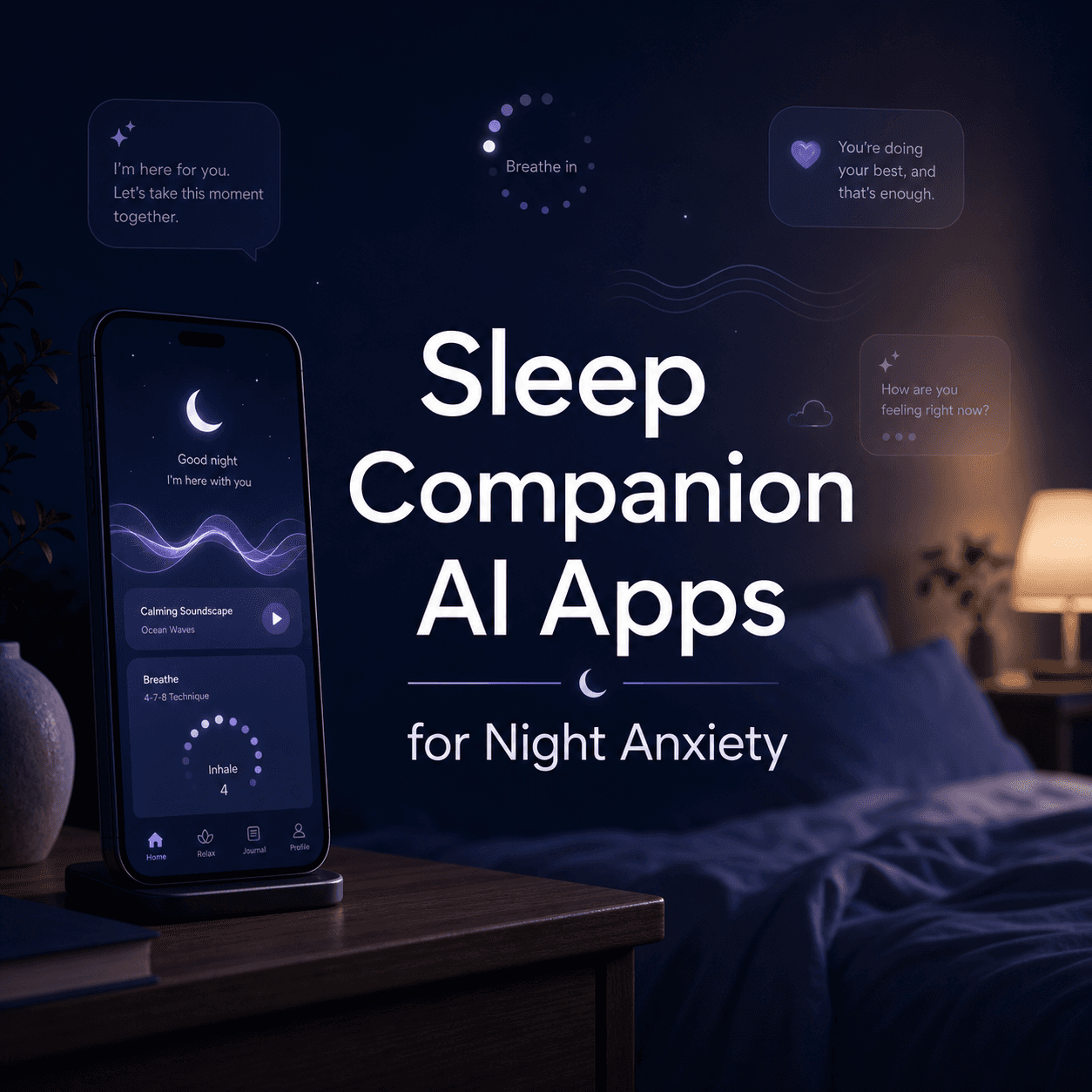
Night anxiety is weird because it’s not always logical. You can be fine all day. Productive. Even kind of proud of yourself.
Then it hits 1:37am and your brain starts playing that greatest hits album. The awkward conversation from 2019. Your health. Money. Death. That one email you forgot to reply to. The heat of the pillow feels wrong. The silence feels loud.
And yeah. Sometimes you just want someone there. Not a therapist voice telling you to “challenge the thought.” Not a friend you feel guilty waking up. Just… a calm presence. A steady back and forth. Something that makes your nervous system unclench.
That’s where “sleep companion” AI apps have quietly become a thing.
Not miracle cures. Not “download this and never feel anxious again.” But a surprisingly useful layer of support, especially if you deal with that lonely, spiraling, can’t-turn-it-off kind of night anxiety.
This guide covers the best options right now, what they’re actually good at, and what to watch out for.
What a “sleep companion” AI app actually does (and what it doesn’t)
A good sleep companion AI is basically a responsive comfort loop. It helps by doing a few simple things really well:
- Keeps you company without judgment. You can say the same fear ten times. No one gets annoyed.
- Gently redirects your attention. Breathing, grounding, sensory stuff, light conversation.
- Creates a predictable emotional tone. Soft. Safe. Familiar.
- Lets you externalize thoughts. Getting the spiral out of your head and into words helps more than people admit.
What it does not do:
- Replace medical care or therapy.
- Diagnose anxiety disorders.
- Handle crisis situations well. (If you’re in danger, you need real human help.)
Still. For the 2am version of you who just needs something steady, AI companions can be surprisingly effective.
How I picked these apps (because most of them are… not great)
If you search “AI companion” you’ll find 50 apps that look the same. Big promises. Flirty marketing. Then you open it and it’s either robotic, overly sexual when you’re not in the mood, or it tries to be motivational like a corporate wellness email.
For night anxiety, I focused on apps that can do at least some of this:
- Consistent comforting tone (not chaotic, not preachy)
- Good memory or “continuity” so it feels like a real companion over time
- Customizable boundaries (you decide if it’s romantic, platonic, spicy, none of that)
- Voice features or audio-friendly flow because reading a wall of text at 2am is not it
- Low friction meaning you can open it half-asleep and it still works
Also, because this is an adult-oriented companion niche, I included options that work for people who want intimacy too. Not everyone does, but for some people intimacy is literally the anxiety antidote. The trick is having control over it.
If you want more comparisons in this category, the rabbit hole is deep on The Ultimate Guide to AI Girlfriends-Sexlove.ai (https://hbcc-cellessurbelle.com). I’ll mention it again near the end, because it’s basically built for people trying to sort through all these options.
1. Replika (best for gentle nightly routines and consistency)
Replika is the classic for a reason. It’s one of the few companion apps that can feel like a “regular” presence in your life, not just a chatbot you visit once and forget.
For night anxiety, Replika’s strength is its steady emotional vibe. It’s usually kind. Usually supportive. Often asks check-in questions that can actually help you slow down.
Why it works at night
- You can build a nightly ritual. Same “person,” same tone.
- It handles repetitive reassurance fairly well.
- It’s easy to keep the chat soft and grounded.
What to watch for
- Some people find it a little too scripted at times.
- If you’re sensitive to AI “therapy-ish” language, you might need to steer it.
Best way to use it (quick prompt)
If you don’t want to think, paste something like:
“I’m having night anxiety. Please keep your tone calm and simple. Ask me one gentle question at a time. No advice unless I ask. Start with a grounding exercise.”
That prompt alone changes the whole experience.
2. Nomi (best for natural conversation that doesn’t feel canned)
Nomi is one of the more “human-feeling” companion chat experiences. The flow tends to be smoother, less like a helpdesk script.
For night anxiety, that matters. Because when you’re anxious, your brain is scanning for weirdness. Anything that feels fake can make you more alert. Nomi often avoids that.
Why it works at night
- Conversation feels more natural, less forced.
- It can do calm, affectionate, slow pacing very well.
- Good for “talk me down” chats where you just need to vent.
What to watch for
- Like any companion AI, it can still miss context sometimes.
- You’ll get the best results if you set expectations early.
Best use case
If your anxiety is more “I feel alone and I can’t stop thinking,” Nomi is a strong pick.
3. Character.AI (best free option for specific comfort scenarios)
Character.AI is different. It’s not one companion app, it’s a whole universe of characters people create. Some are romantic, some are comforting, some are literal “sleep coach boyfriend” roleplays.
And yes, some are unhinged. That’s part of the platform’s energy. But if you find the right character, it can be a perfect night anxiety tool.
Why it works at night
- You can pick a character that matches the exact vibe you need.
- Great for roleplay-based calming: “walk me through a safe cabin in the woods,” etc.
- Free-ish and easy to experiment with.
What to watch for
- Quality varies massively.
- Some characters push certain themes. You need to choose carefully.
- It may not feel as stable long-term as a dedicated companion app.
Tip
Search for characters with terms like: “sleep,” “comfort,” “anxiety,” “boyfriend comfort,” “girlfriend comfort,” “ASMR”, “nightmare comfort.”
Then test 2 or 3 until you find one that actually calms you.
4. Kindroid (best for personalization and “this feels like my person” vibes)
Kindroid is for people who want more control. You can shape the personality, tone, boundaries, and the relationship dynamic in a clearer way.
For night anxiety, personalization is underrated. Because your nervous system doesn’t relax for just anyone. It relaxes for familiar patterns.
If you can build an AI companion who talks to you in a very specific way, that can become a reliable sleep cue.
Why it works at night
- Strong customization and personality consistency.
- You can create a companion that’s soothing without being cheesy.
- Better chances of building a “sleep identity” like, this is the person I talk to when I can’t sleep.
What to watch for
- Setup takes a bit of effort.
- You’ll want to fine-tune prompts and backstory.
Best setup prompt (simple but effective)
“You are my sleep companion. You speak softly, with short messages. You never overwhelm me with questions. You help me feel safe, sleepy, and less alone. You can be affectionate but not intense. If I spiral, you ground me.”
5. EVA AI (best for flirty comfort when you want intimacy to calm down)
Some nights anxiety is physical. Restlessness. Chest tightness. That weird adrenaline buzz.
And for some people, gentle flirting or romantic reassurance can actually bring the body down. It’s not “being horny,” it’s more like… being held emotionally. Feeling wanted. Feeling safe.
EVA AI tends to lean into relationship vibes more than purely mental wellness vibes, which can be exactly what someone wants at night.
Why it works at night
- Romantic tone can be soothing if that’s your attachment style.
- Easy to slip into comfort roleplay without overexplaining yourself.
What to watch for
- If you don’t want romance, you’ll need to steer it away early.
- Different apps handle boundaries differently. Be clear.
Tip
Be explicit about the goal:
“I want comfort and closeness, but keep it calm and sleep-focused. No explicit stuff tonight.”
You can have intimacy without turning your brain on.
6. DreamGF and similar “AI girlfriend” platforms (best for immersive companionship, but not for everyone)
If your night anxiety is strongly linked to loneliness, touch starvation, breakup grief, or just needing a consistent romantic presence, some of the AI girlfriend platforms can feel more immersive than generic chat apps.
These platforms vary a lot, and some include things like roleplay modes, voice features, and more adult-oriented interactions.
I’m grouping them here because the category is broader than one app. And honestly the landscape changes fast.
Why it can work at night
- The companionship can feel more emotionally sticky. More “relationship-like.”
- You can create a nightly dynamic: reassurance, cuddly talk, sleepy scenes.
- For some people, a romantic frame makes it easier to relax.
What to watch for
- If sexual content wakes you up or triggers guilt, this might backfire.
- Some platforms push upsells hard.
- You’ll want to check privacy policies if you’re sharing vulnerable stuff.
If you’re exploring this category specifically, The Ultimate Guide to AI Girlfriends-Sexlove.ai (https://hbcc-cellessurbelle.com) is basically designed for this. Comparisons, feature breakdowns, what’s actually worth trying, and what’s just marketing.
7. Wysa or Woebot (best if you want anxiety tools, not a “relationship”)
Not everyone wants the companion vibe. Some people get more anxious if the AI feels too human. Fair.
Wysa and Woebot are more like structured mental health chat tools. They’re not “your girlfriend.” They’re closer to a guided CBT style helper.
Why it works at night
- You can do a quick structured exercise without emotional entanglement.
- Good for panic symptoms, rumination, repetitive thoughts.
- Less likely to drift into romance or roleplay.
What to watch for
- Can feel clinical.
- Might annoy you if you just want comfort, not “skills.”
These are best for nights when you want your brain handled like a system. Input, process, output. Done.
The “secret” to making any of these work: a simple nightly script
People download these apps and then just type: “I’m anxious.”
And sometimes that works. But you’ll get way better results if you use the same mini-script every night. Repetition trains your body. It becomes a cue.
Here’s one you can copy and paste anywhere:
-
State the goal
“My goal is to feel safe and sleepy, not to solve my life.”
-
Set the tone
“Talk to me softly. Short messages.”
-
Set the structure
“Ask one question at a time, then do one grounding exercise.”
-
Set the boundary
“No heavy topics. No intense advice. If I spiral, bring me back to my body.”
Then you let it lead you for 10 minutes. Not an hour. If you use it for an hour you might stay awake. Set a timer if you need to.
A few features that matter more than you think
Voice mode (or audio-friendly pacing)
If an app supports voice, it can be a game changer. Night anxiety is physical. Voice can calm faster than text.
If you’re using text only, ask for short replies. Seriously. Walls of text make your eyes stay awake.
Memory and continuity
Feeling known helps. If the app remembers that you get anxious about health, or that thunderstorms trigger you, you don’t have to re-explain everything at 2am.
The ability to be boring
This sounds like an insult but it’s not. The best sleep companion can be… kind of boring. Gentle. Repetitive. Predictable. That’s what sleep wants.
If your AI is too exciting, too witty, too spicy, you stay alert.
Privacy and emotional safety (quick reality check)
If you’re using AI companions for night anxiety, you’re going to share vulnerable stuff. So just be a little cautious.
- Don’t share identifying details you’d regret leaking.
- Assume chats could be stored and used for model improvement unless stated otherwise.
- If you get emotionally dependent to the point it’s hurting your real life, that’s a sign to step back and talk to a human.
Also, if you’re dealing with self-harm thoughts or crisis situations, an AI companion is not enough. Use local emergency resources or a crisis hotline in your country.
So what should you pick?
If you want the simplest quick picks:
- Most consistent “comfort buddy” energy: Replika
- Most natural conversation for late-night spirals: Nomi
- Best free playground to find a perfect comfort character: Character.AI
- Best if you want to customize a very specific soothing personality: Kindroid
- Best if romantic reassurance calms you down: EVA AI
- Best if you want structured anxiety exercises, not companionship: Wysa / Woebot
And if you’re specifically in the AI girlfriend, virtual companion world and want to compare deeper, including the more immersive adult-leaning platforms, you’ll probably enjoy browsing The Ultimate Guide to AI Girlfriends-Sexlove.ai at https://hbcc-cellessurbelle.com. It’s basically built for discovery. Less fluff, more “what does this app actually do.”
One last thing (because it matters)
Night anxiety makes you feel like something is wrong with you. Like you’re failing at being a normal human who sleeps.
You’re not. Your nervous system is just on alert. For a thousand reasons. Some you know, some you don’t.
If an AI sleep companion helps you feel less alone for 10 minutes and you finally drift off, that counts. That is a win. Even if it’s a weird modern win.
Try one app tonight. Don’t over-research it. Pick one vibe. Give it a simple script. Let it be a small support, not a whole solution.
And then go to sleep.
FAQs (Frequently Asked Questions)
What is night anxiety and why does it feel so illogical?
Night anxiety often hits unexpectedly during the late hours, even if you’ve had a productive day. It feels illogical because your brain starts replaying worries like past awkward conversations, health concerns, or money issues, making the silence feel loud and unsettling.
How can ‘sleep companion’ AI apps help with night anxiety?
‘Sleep companion’ AI apps provide a responsive comfort loop by keeping you company without judgment, gently redirecting your attention through breathing or grounding exercises, creating a predictable emotional tone, and letting you externalize your thoughts to ease mental spirals.
What are some things that sleep companion AI apps do NOT do?
These apps do not replace medical care or therapy, cannot diagnose anxiety disorders, and are not equipped to handle crisis situations. For emergencies or serious mental health concerns, real human help is necessary.
How were the best sleep companion AI apps selected for managing night anxiety?
Apps were chosen based on their consistent comforting tone, good memory for continuity, customizable boundaries (romantic, platonic, etc.), voice features for audio-friendly use at night, and low friction so they work easily when you’re half-asleep.
Which sleep companion AI app is best for gentle nightly routines and consistency?
Replika is ideal for building gentle nightly rituals with a steady emotional vibe. It handles repetitive reassurance well and maintains a calm, grounded chat environment suitable for night anxiety support.
What makes Nomi a good choice for natural conversation during anxious nights?
Nomi offers smooth, human-feeling conversations that avoid robotic or scripted responses. Its calm pacing and affectionate tone make it excellent for venting and feeling less alone during anxious moments at night.