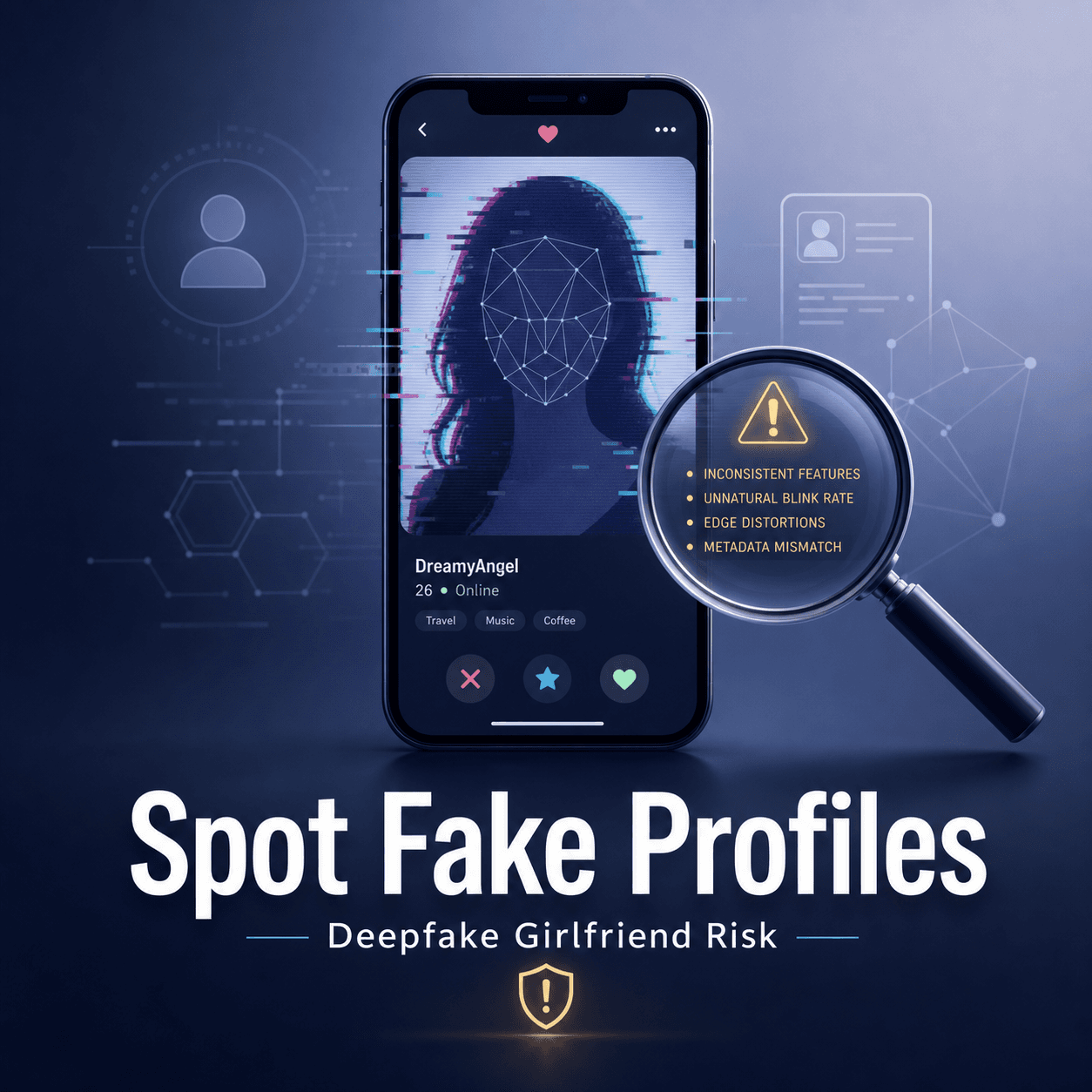
A weird thing is happening online right now.
It used to be pretty simple. You met someone, you chatted, maybe you hopped on a call, maybe you didn’t. But at least the basics were clear.
Now you can be talking to a “girlfriend” who has a flawless photo set, a convincing voice note, and a short video clip where she smiles and says your name. And none of it has to be real. Not the face, not the voice, not even the person behind the chat.
Deepfakes and AI generated media are not just a celebrity problem anymore. They are showing up in dating apps, Telegram, Reddit, X, Instagram, Discord. And yes, in the wider AI companion space too, because the line between “virtual companion” and “real person” gets blurry fast if someone wants it to.
This guide is here for one reason. So you can spot fake profiles early. Before you get emotionally hooked, before you send money, before you hand over personal photos, before you give someone your real name and workplace because it “feels safe”.
If you are exploring AI girlfriend apps on purpose, that’s a different thing. That’s consent. That’s the deal. The problem is when someone pretends to be a real woman and uses deepfake media to bait you into a relationship, or into a scam.
Let’s get into it.
What a “deepfake girlfriend” usually means in practice
Most people imagine deepfakes as some high budget video where a face is swapped perfectly.
In real scams it’s messier. It’s a stack of tactics.
A “deepfake girlfriend” profile often combines:
- AI generated photos (or stolen photos touched up with AI)
- A few short deepfake video clips, usually low motion, low light, or heavily filtered
- Voice cloning for quick voice notes
- Chat scripts that feel intimate fast, sometimes assisted by AI
- A pressure path toward moving off platform and escalating trust
The goal can be money. Sometimes it’s blackmail. Sometimes it’s collecting explicit content. Sometimes it’s just attention farming with affiliate links. But the pattern tends to look the same.
And the scariest part is that one good clip can override your instincts. You think, she sent a video, so she must be real. That’s the trap.
The biggest red flags (the ones that actually show up)
Here are the signs that show up again and again. One by itself is not proof. Three or four together, you should slow down.
1. Photos look “too consistent” but also… generic
AI generated faces often have a certain polished sameness. Perfect skin, perfect lighting, perfect composition. Like every picture is a profile photo.
Look for:
- No messy life photos. No awkward angles. No bad lighting.
- No context. No friends. No family. No workplace. No random background clutter.
- A weird lack of continuity. Same face but slightly different nose shape, jawline, or ear shape across images.
Real people post imperfect stuff. Even curated people have at least one photo that feels like a human took it on a Tuesday.
2. Earrings, glasses, teeth, and hands don’t behave normally
This sounds nitpicky until you try it.
AI and deepfake artifacts often show up in:
- Hands and fingers (extra fingers, melted knuckles, uneven nails)
- Teeth that blur together when smiling
- Earrings that change shape or don’t match
- Glasses frames that warp into the face
- Hairlines and baby hairs doing strange stuff near the forehead
Zoom in. Don’t just glance. Your brain wants to see a person. Make it work a little.
3. The profile has high “male fantasy” optimization
It’s not about judging preferences. It’s about bait.
If the profile reads like it was engineered to hook lonely men fast, be careful.
Examples:
- Overly sexual bio right away
- Overly submissive vibe, instantly calling you “babe” or “husband”
- The same templated lines you have seen in scam accounts
- Immediate reassurance like “I hate liars” or “I’m not like other girls” before you even asked
When someone leads with intimacy instead of curiosity, that’s often manipulation.
4. Rapid escalation off platform
This is one of the clearest signs.
They will push you to:
- WhatsApp, Telegram, Signal
- Google Chat or email
- A “private fan page”
- A random video app link
- A crypto wallet “because it’s easier”
The reason is simple. Most platforms have fraud detection, reporting, and moderation. Off platform, you are alone.
If you hear “I don’t use this app much” within the first hour, slow down.
5. Video clips are short, filtered, and low movement
Deepfake scammers love short clips because they are easier to fake.
Things to watch:
- The video is under 5 seconds, often looping
- Heavy beauty filters, low light, or moving camera
- The face looks “stuck” to the head, or the skin looks too smooth
- Lip sync is slightly off, especially on consonants like P, B, M
- Teeth and tongue look blurred in motion
Also watch the edges. Jawline, cheeks, hairline. That’s where a lot of fakes fall apart.
6. Voice notes sound “perfect” but emotionally flat
Voice cloning is getting scary good. But a lot of scam voice notes still sound like:
- Clean studio audio when it should be casual
- Odd pacing, like the pauses are wrong
- Emotion that doesn’t match the context
- Weird pronunciation on names, locations, or slang
Try this. Ask them to say a very specific sentence with a weird phrase. Not just your name.
If they dodge it, that’s telling.
7. They avoid real time interaction, always
This is the classic.
They will:
- Agree to video call, then “something happened”
- Have constant emergencies
- Be in a country with “bad internet”
- Only send pre recorded clips
- Only text during certain hours
Even if someone is shy, they can do a simple real time verification eventually. A 10 second live call, no filters, normal light.
If weeks go by and it never happens, assume it’s not real.
Quick verification tests that don’t feel like an interrogation
You don’t want to turn every chat into a police interview. Fair.
So these are softer tests. They work because deepfake and fake profile setups hate unpredictability.
Ask for a live “gesture check”
Simple request:
“Can you hop on a quick video for 10 seconds and do a peace sign then touch your ear?”
Deepfakes can struggle in real time with specific gestures, especially if the scammer is relying on pre made clips.
If they say yes but it’s still pre recorded, you’ll notice because your request won’t match what they do.
Ask for a photo with a specific detail
Not “send a selfie”.
Ask:
“Can you take a selfie holding a spoon”
or
“Can you write today’s date on a piece of paper and hold it”
This used to be enough. Now it’s not perfect because AI can generate it. But it increases their effort cost. Most scammers move on.
Ask about local specifics that are hard to fake smoothly
If they claim they live in your city, ask something normal:
- “What’s a cafe you like near you?”
- “Which neighborhood do you actually live in?”
- “What’s the weather like right now, is it humid?”
Scammers can Google. Sure. But they often answer in a vague way. Or they pick tourist answers.
Reverse image search, but do it properly
Do not just use one tool.
Try:
- Google Images
- Bing Visual Search
- TinEye
- Yandex (still surprisingly good at finding stolen sets)
If the image is AI generated, you might not find matches. But if it’s stolen, you often will. And stolen content is still incredibly common.
Look for “photo set logic”
Ask yourself: do these photos look like they were taken by the same person over time?
Things that break the logic:
- Multiple countries in the background with no explanation
- Different phone camera quality every time
- No seasonal consistency
- No repeated locations, ever
Real people have patterns. Same mirror, same bedroom corner, same park, same messy desk. Scammers avoid patterns because it exposes them.
The money and blackmail paths, because this is where it gets ugly
A deepfake girlfriend scam almost always tries to move you into one of these.
The “I need help” script
It starts small. A phone bill. A ride. A sick parent. A visa fee. Rent.
The amounts are usually low at first because the goal is psychological commitment. Once you pay once, you are more likely to pay again.
Rule: if you have never met, never verified, and they ask for money, it’s a no. Every time.
The “investment” script
Crypto, Forex, “my uncle’s platform”, “I can teach you”.
This one is massive right now.
Even if the girl seems real, it can be a whole team behind it. A real face used as bait, with scammers running the chat. You get guided to a fake investment site.
If romance meets finance fast, assume it’s a setup.
The “sextortion” script
This is brutal and common.
They push sexual content early, then they ask you for:
- nude photos
- videos
- live cam
- your socials
Then they threaten to send it to your family or workplace.
Deepfake makes this worse because they can also fabricate content that looks like you, even if you never sent anything explicit. A face swap onto adult content, then blackmail.
Protect yourself:
- Keep your socials private
- Don’t share your full name, workplace, or city early
- Don’t send explicit content to unverified people, period
- If threatened, stop engaging, screenshot everything, report, and consider local law enforcement
How to tell the difference between an AI companion and a fake “real” girlfriend
This matters on a site like The Ultimate Guide to AI Girlfriends-Sexlove.ai because a lot of readers are intentionally exploring virtual companions. No shame in that. But clarity matters.
An AI companion app should be transparent:
- It tells you it’s AI.
- It explains what media is generated.
- It has boundaries, terms, and safety features.
- It doesn’t pretend there is a real human behind the profile.
A deepfake girlfriend scam is the opposite:
- It insists it’s a real person.
- It uses fake media to “prove” it.
- It avoids verification that would prove real time identity.
- It pushes for money, secrets, or leverage.
If you want a digital relationship that is actually honest, stick with platforms that clearly label AI generated chat, images, and video features. That’s part of why people use companion apps in the first place. You know what you’re dealing with.
If you want comparisons and breakdowns of AI companion platforms and how they handle chat, voice, and video features, you can browse the guides on https://hbcc-cellessurbelle.com. Use it like a filter. It saves you from guessing.
A simple checklist you can use in 2 minutes
When you’re not sure, run this list.
Profile signals
- Photos have real life messiness and context
- Bio is not hyper sexual or templated
- Story is consistent across chats
- They don’t push off platform immediately
Media signals
- No obvious artifacts in hands, teeth, hairline, earrings
- Video has normal lighting, normal movement, not overly filtered
- They can do a live gesture check on request
- Voice note has natural pacing and matches their claimed background
Behavior signals
- They answer specific questions without dodging
- They don’t have endless emergencies when it’s time to verify
- No money requests, no crypto, no gift cards
- No pressure, no guilt, no threats
If you can’t check the boxes, don’t “wait and see” for weeks. That’s how you get attached.
If you already got fooled, do this next (no panic, just steps)
It happens. People don’t talk about it because it’s embarrassing. But it’s common, and scammers are good at what they do.
- Stop sending money or content immediately. No final payment. No “closure call”.
- Save evidence. Screenshots, usernames, payment receipts, wallet addresses, voice notes.
- Block and report. On the platform, and on any payment service used.
- Lock down your accounts. Change passwords, enable 2FA, review privacy settings.
- If sextortion is involved, do not negotiate. Document, report, and get support. Many jurisdictions treat this seriously now.
- Talk to someone you trust. One person. It breaks the isolation, which is what scammers rely on.
The uncomfortable truth: your feelings are the vulnerability, not your intelligence
People like to think only gullible users fall for this.
Not true.
Deepfake girlfriend scams target normal needs: attention, comfort, intimacy, being seen. If you are lonely, stressed, going through a breakup, working too much, whatever. That is the opening.
So the goal isn’t to become paranoid. It’s to become slower. Slightly more annoying to scam.
Make them verify. Make them be real time. Make them show consistency. If they can’t, you walk.
That’s it.
A final note (and a safer way to explore this space)
If what you actually want is the feeling of companionship, flirting, intimacy, and you don’t want the risk of being lied to by a “real person” who is actually a scammer, then leaning into transparent AI companion platforms is often safer. At least the terms are clear.
If you are exploring that route, you can start with the comparisons and guides on The Ultimate Guide to AI Girlfriends-Sexlove.ai at https://hbcc-cellessurbelle.com. Use it to understand what features are real, what is generated, what safety controls exist, and what to avoid.
And if you are dealing with a profile right now that feels slightly off, trust that. Do one verification test today, not next week. If they disappear, you didn’t lose a girlfriend. You dodged a problem.
FAQs (Frequently Asked Questions)
What is a “deepfake girlfriend” in online dating contexts?
A “deepfake girlfriend” refers to a fake online profile that uses AI-generated photos, short deepfake video clips, voice cloning, and scripted chats to impersonate a real woman. These profiles are designed to deceive users into emotional relationships or scams by presenting convincing but fabricated media.
How can I spot AI-generated photos used in fake dating profiles?
AI-generated photos often look too polished and consistent, featuring perfect skin, lighting, and composition without messy life photos or random backgrounds. They may also show inconsistencies like changing facial features across images and lack authentic context such as friends, family, or workplace settings.
What are common red flags indicating a deepfake or scam dating profile?
Key red flags include overly sexual or submissive bios optimized for male fantasy, rapid pressure to move conversations off-platform (like WhatsApp or Telegram), short filtered videos with unnatural movements, voice notes that sound perfect but emotionally flat, and avoidance of real-time interaction such as video calls.
Why do scammers push conversations off-platform quickly?
Moving off-platform helps scammers avoid fraud detection and moderation present on mainstream apps. Off-platform communication like messaging apps or private fan pages leaves the victim isolated and vulnerable to scams such as money requests or blackmail.
How can I identify fake video clips used by deepfake scammers?
Fake videos are often very short (under 5 seconds), heavily filtered, low lighted, or have minimal movement. Signs include faces appearing stuck to the head, overly smooth skin, slight lip-sync issues especially on consonants like P and B, and blurred teeth or tongue during motion.
What should I do if I suspect someone is using deepfake media to scam me online?
If you notice multiple red flags like inconsistent photos, pressure to move off-platform, suspicious videos or voice notes, or avoidance of real-time interaction, slow down communication. Avoid sharing personal information or money. Report the profile to the platform’s support team and consider blocking the user for your safety.