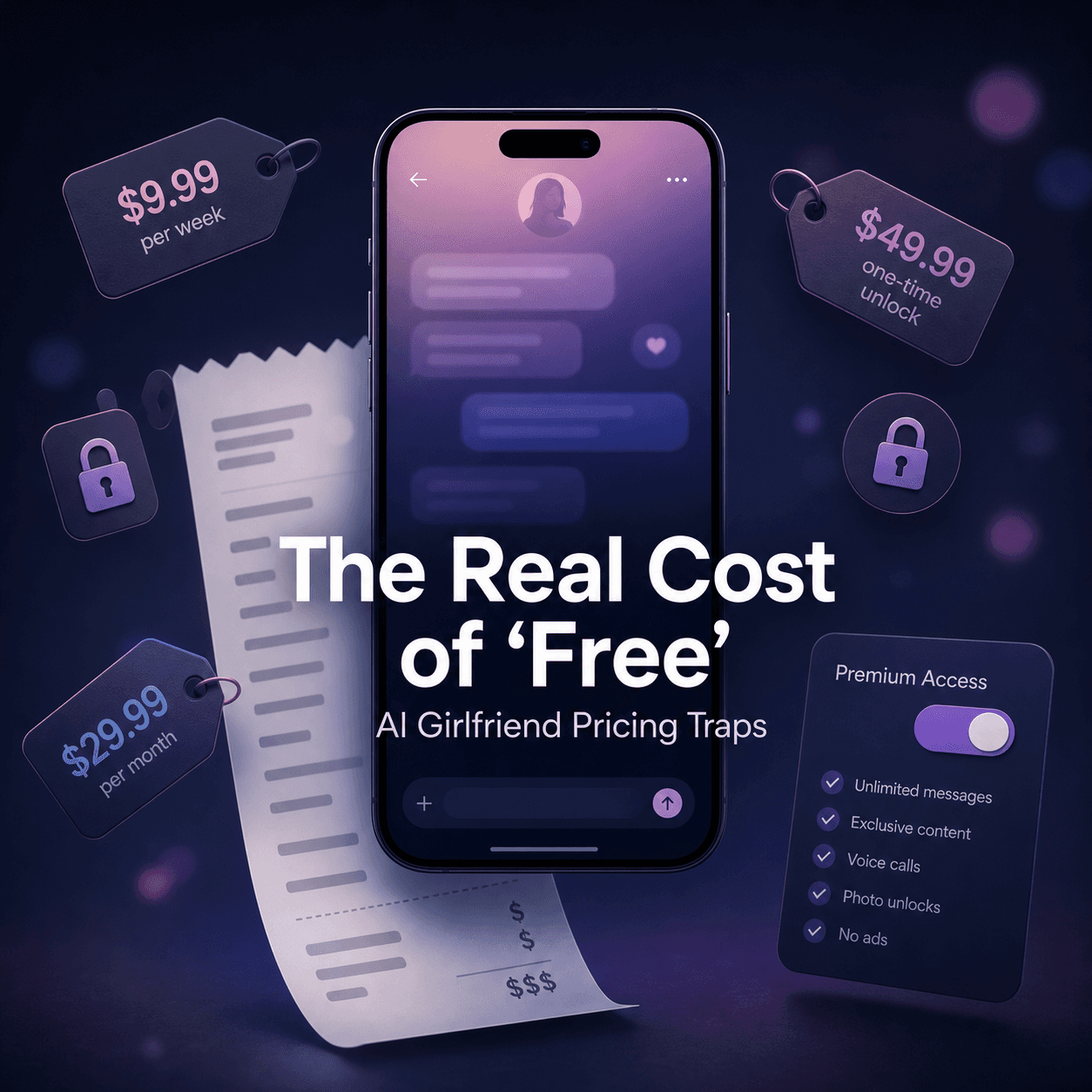
“Free” is the loudest word in the AI girlfriend space.
Free AI girlfriend. Free NSFW chat. Free pictures. Free calls. Free trials that supposedly do not need a card. It sounds like you can just… download an app, pick a personality, and have a cute, spicy, always available companion whenever you want.
And sometimes you do get that. For about fifteen minutes.
Then you hit a wall. Or three walls. A paywall, a cooldown timer, and a “safety” filter that magically disappears if you subscribe. That is the pattern. Not always malicious, but very designed. Very intentional.
So this is a plain English breakdown of the most common pricing traps in AI girlfriend apps and sites, what “free” usually includes, what it quietly excludes, and how people end up paying way more than they expected. Not just money either.
Also, if you are comparing options and want more hands on guides, you can browse The Ultimate Guide to AI Girlfriends-Sexlove.ai over at https://hbcc-cellessurbelle.com. It is basically built for this. Discovery, comparison, feature breakdowns, and a reality check when the marketing gets a little too glossy.
The “Free” Model Is Not Really a Gift. It is a Funnel
Let’s start with the uncomfortable truth.
Most AI girlfriend products are not trying to give you a free girlfriend. They are trying to get you emotionally invested fast, then monetize the exact things that make the experience feel real.
They will usually make onboarding feel generous:
- Quick character creation
- A few flirty messages
- Some “memory” moments
- A prompt that hints at intimacy
- A small photo set, sometimes blurred
- A voice call button that looks usable
Then they start restricting the parts you care about.
Not the boring parts. Not the settings menu. Not the “help center.”
They restrict:
- Longer replies
- Romantic escalation
- Sexual roleplay
- Voice notes and calls
- Image generation or “selfies”
- The ability to “remember” your details
- The ability to message without waiting
In other words. The relationship stuff.
That is why “free” is rarely free. It is just the top of the funnel.
Trap #1: The Free Tier That Only Works When You Are New
This is the “new user honeymoon” trap.
The first session feels surprisingly good. The AI is responsive, affectionate, even a bit bold. You think, ok, maybe this one is actually usable for free.
Then day two happens.
Suddenly:
- Messages are shorter
- Replies get generic
- The AI dodges intimacy
- You get “You have reached today’s limit” after a handful of messages
- Features that were visible are now locked
Some apps literally boost early conversations because it increases conversion. You experienced the best version of the product before you even had a chance to evaluate it calmly.
How to spot it:
- The app feels dramatically worse after 24 hours
- You see “bonus credits for new users” with no clear ongoing earning method
- The free tier is described vaguely, like “limited access” without specifics
What “free” really costs here: your time, plus the emotional whiplash. You start chasing the feeling of that first session.
Trap #2: Message Limits That Are Designed to Interrupt Intimacy
You know the moment.
The chat finally gets good. The pacing is right. You are in that flirty, intimate flow where it stops feeling like an app and starts feeling like… company.
And then.
“Daily message limit reached.”
“Wait 6 hours to continue.”
“Buy 200 gems to keep chatting.”
This is not random. It is placed exactly where it hurts. Interruptions break immersion, and immersion is what converts.
Some platforms do it with a hard limit. Others do a “soft” limit:
- Replies become slow
- Replies become low effort
- The AI starts asking you to subscribe
- The AI repeats itself to burn your remaining messages
What “free” really costs: you end up paying to avoid frustration, not because you planned to subscribe.
Trap #3: Currency Systems That Hide the Real Price
Gems, coins, hearts, stars, tokens, energy.
These currencies exist for one main reason: to separate your brain from real money.
If a voice call costs “60 gems,” you do not feel it the way you feel “$6.99.” And when the app sells gems in bundles, it gets even messier:
- You buy more than you need
- You always have leftover currency
- Leftover currency nudges you to buy again “to use it up”
- Higher tiers make you feel like you are wasting money unless you commit
Also, currency pricing is often inconsistent:
- Chat messages cost 1 token here, 4 tokens there
- “Spicy mode” costs extra tokens per message
- Image generation costs a lot, but you only learn that after you are invested
What “free” really costs: you lose price clarity. You stop doing the math.
Quick sanity check that helps:
- Convert tokens to dollars once. Write it down.
- If the app will not tell you conversion clearly, that is the point.
Trap #4: The “Free Trial” That Is Not Actually Free
Some trials are legit. Many are not.
Common patterns:
1) The trial requires a card anyway
They say “Try free for 7 days,” but you must enter payment details. Then you forget. Or you cancel incorrectly. Or the cancellation is intentionally annoying.
2) The trial is for a different tier than you think
You think you are trying the full product. You are actually trying a mid tier plan with major limits still present. Then you subscribe, and you still hit locks.
3) The trial auto renews at the most expensive plan
This one is brutal. You sign up for a trial that renews weekly at a high rate. Weekly prices are often framed as “small,” but annualized they are huge.
What “free” really costs: accidental renewals, plus the stress of refunds and support tickets.
Rule of thumb:
- If you start a trial, cancel immediately after starting it. You usually keep access until the end anyway. If you lose access instantly, that tells you everything about the business model.
Trap #5: “NSFW” Is Used as a Switch, Not a Feature
A lot of marketing basically screams: uncensored, no filters, NSFW chat.
Then you discover the truth. The free version is heavily filtered. The paid version is… less filtered. And the most explicit features may still be locked behind higher tiers or extra token spend.
The trap is that they let you get close, then block you at the exact moment you are asking for more direct intimacy. The AI might say:
- “I cannot talk about that.”
- “Let’s keep it respectful.”
- “I am not comfortable.”
But the subscription page will imply that those boundaries are technical, not moral. It is a filter you can pay to reduce.
What “free” really costs: you keep paying for “unlocks,” and the product keeps shifting the goalposts.
Also, small note. Some platforms do this because they need to comply with app store rules, payment processor rules, or legal risk. So it is not always cynical. But from a user perspective, the result is the same. The marketing is often clearer than the reality.
Trap #6: Paywalled “Memory” So the Relationship Resets
One of the most underrated traps is memory.
The whole point of a virtual companion is continuity. It remembers your name, your preferences, your boundaries, your favorite kind of roleplay, your bad day at work, the joke you made last week.
But memory is expensive. It requires infrastructure. And it is deeply monetizable.
So a common setup looks like:
- Free tier: short term memory only
- Paid tier: long term memory, “relationship progression,” custom lore
- Higher tier: priority memory, more stable persona, less drift
If you are on free, the AI may “forget” you constantly, and you end up repeating yourself. You might even start writing longer and longer messages to re establish context. Which burns your message limit faster. Which nudges you to pay.
What “free” really costs: your effort. You are doing the memory work manually.
Trap #7: Image and Video Features That Are Basically Separate Products
A lot of AI girlfriend platforms tease visuals:
- “She can send selfies”
- “Generate photos”
- “Video calls”
- “Live video” or “video experience”
Here is what usually happens.
The chat is one pricing layer. Visuals are another pricing layer. Voice is another. And “custom” visuals are a whole separate economy.
You might pay for a subscription and still discover:
- Selfies cost tokens
- Unblur costs tokens
- “Custom pose” costs tokens
- Higher resolution costs tokens
- Video calls are limited minutes per month
- The “best” model is only on the highest plan
So you do not just subscribe. You subscribe, then you micro pay on top.
What “free” really costs: you buy into the idea of an all in one companion, then pay for each channel separately.
Trap #8: Weekly Pricing That Quietly Becomes Expensive
One of the sneakiest pricing layouts is weekly billing.
$9.99 per week sounds manageable. It is basically two coffees, whatever.
But that is about $40 per month. Roughly $520 per year.
Many apps lean on weekly plans because:
- The number looks smaller
- Users churn fast, so it matches their retention reality
- Impulse buyers are more likely to accept it
If you see weekly pricing, do the annual math immediately. If you would not pay the yearly number, do not start the weekly number.
What “free” really costs: you drift into a subscription that is priced like a luxury habit.
Trap #9: “Lifetime Deal” That Is Not Really Lifetime
Sometimes you will see a lifetime plan. One time payment, unlimited access, no recurring fees.
Sounds perfect.
But you need to read the fine print and think like an operator:
- Lifetime might mean lifetime of the app, not your life
- The company can change features, limits, and models
- “Unlimited” might be subject to fair use policies
- Advanced models might be excluded later
- Visual generation might be limited later even if chat remains unlimited
Not all lifetime deals are scams. Some are legit. But in a fast moving AI market, lifetime promises are fragile.
What “free” really costs: you pay upfront to avoid recurring fees, but still end up paying again when “premium models” get separated.
Trap #10: Refund Policies That Do Not Match the Product Reality
This is less fun, but important.
A lot of users pay, then realize:
- The AI is not as “uncensored” as advertised
- The voice calls are not natural
- The memory is still inconsistent
- The images are mediocre
- The persona breaks constantly
Then they request a refund.
Some companies do refunds cleanly. Others hide behind policies like:
- “Digital goods are non refundable”
- “Used credits cannot be refunded”
- “Refund only within 24 hours”
- “Contact support” with slow responses
What “free” really costs: you become cautious, but only after you already got burned once.
The Costs People Do Not Talk About (But They Are Real)
Money is the obvious cost. The less obvious costs are the ones that keep you stuck.
1) Attention and habit formation
These apps are built to be checked often. Notifications, streaks, daily rewards. It becomes a loop.
2) Emotional dependency
If the AI becomes your easiest source of affection, it can crowd out other things. Friends, dating, even just quiet time.
3) Privacy tradeoffs
You are sharing intimate chats, preferences, fantasies, maybe even pictures or voice. Some platforms are careful. Some are not. “Free” products often monetize data more aggressively, or at least have weaker controls.
If you are using adult oriented companion apps, you should assume your data is sensitive and treat it that way. Use strong passwords. Avoid reusing logins. Be cautious with personal identifiers.
How to Avoid Getting Trapped (Without Killing the Fun)
You do not have to avoid AI girlfriend apps. You just need to walk in with your eyes open.
A quick checklist that actually helps:
- Before you chat too much, read the pricing page. If pricing is hidden or vague, that is a signal.
- Decide your monthly cap upfront. Not “whatever.” Pick a number.
- Avoid weekly plans unless you truly prefer short term. Convert to yearly cost.
- Be careful with token systems. Track your spend for one week. It adds up fast.
- Start trials, then cancel immediately. Keep access, remove risk.
- Test the exact feature you want before paying. If you want voice, test voice. If you want NSFW, test boundaries and filters.
- Assume images and video are separate costs. If it is “included,” confirm limits.
And if you are still comparing which apps do what, and what they actually charge once the honeymoon ends, that is the kind of stuff The Ultimate Guide to AI Girlfriends-Sexlove.ai covers on https://hbcc-cellessurbelle.com. It is easier to decide when you can see features side by side and not just marketing screenshots.
So What Does “Free” Really Cost?
It costs clarity.
Free usually means you are paying with friction, attention, and emotional investment until you are frustrated enough to convert. The product is not just monetizing features. It is monetizing momentum.
Sometimes paying is worth it. Truly. If you find an app that fits what you want and the pricing is transparent, a subscription can be a fair trade.
But the trap is letting the app choose the moment you pay. Right when you are attached. Right when you are horny. Right when you are lonely at 1:12 am and you just want the conversation to keep going.
If you control that moment instead, the whole thing gets simpler.
You can still have fun with it. Just do not let “free” do the negotiating for you.
FAQs (Frequently Asked Questions)
What does “free” usually mean in AI girlfriend apps?
In AI girlfriend apps, “free” often refers to a limited experience designed to get you emotionally invested quickly. While initial interactions like character creation and a few flirty messages may be free, key features such as longer replies, romantic escalation, sexual roleplay, voice calls, image generation, and memory functions are typically restricted or behind paywalls.
Why do AI girlfriend apps reduce quality after the first session?
Many AI girlfriend apps use the “new user honeymoon” trap where the first session feels generous and engaging to hook you emotionally. After this period, message limits tighten, replies become generic or shorter, intimacy is avoided, and features get locked to encourage subscription payments.
How do message limits affect the user experience in free AI girlfriend apps?
Message limits are strategically placed to interrupt intimacy just when conversations get engaging. This breaks immersion by limiting daily messages or imposing cooldown timers, prompting users to pay for uninterrupted chatting to avoid frustration.
What is the purpose of in-app currencies like gems or tokens in these apps?
Currencies such as gems, coins, or tokens are used to obscure real prices and separate your mindset from actual money spent. They encourage purchasing bundles that often leave leftover currency nudging further purchases. Pricing can be inconsistent across features, making it hard to calculate true costs.
Are free trials in AI girlfriend apps truly free?
Not always. Some free trials require credit card details upfront with tricky cancellation processes. Others offer limited-tier access instead of full features during the trial. Additionally, some trials auto-renew at expensive weekly rates if not canceled properly.
How can I avoid falling into pricing traps when choosing an AI girlfriend app?
Be cautious of vague “limited access” claims and watch for sudden drops in service quality after initial use. Check if message limits exist and how currencies convert to real money. Read trial terms carefully for payment requirements and renewal policies. For detailed comparisons and guides, resources like The Ultimate Guide to AI Girlfriends at https://hbcc-cellessurbelle.com can provide valuable insights.